Hi-Lo Casino UK: Rules, Versions and Online Play
 Available in GB
Hi-Lo outcomes depend on the version in play, especially whether matching the reference card is a separate wager or a loss.
Table of Contents
The Card That Sets the Terms
Hi-Lo begins with a comparison. A card is visible, and the player must judge whether the next one will rank higher or lower. Some versions add a third possibility: a wager that the next card will have the same value. The rules may look spare, but the treatment of that middle outcome changes the character of the choice.
A tie is not automatically a win for anyone who called higher or lower. In versions where those are the available bets, drawing the same value as the reference card makes the wager lose. The prediction can be close in the ordinary sense and still be wrong by the game’s definition. That is the small, decisive distinction in a hi-lo casino game: being near the answer is not the same as naming the outcome the rules recognise.
The choice is therefore not simply between two directions. It is also a choice made under a particular contract about what happens in the space between them. A version that permits a bet on the same value treats the tie as a named possibility. A version that offers only higher and lower assigns it to neither side, and a tie defeats either call. The card has not moved; the terms have.
This matters because the visible card encourages a tidy mental picture: lower on one side, higher on the other, with a line dividing them. But the line itself is part of the game’s design. If a tie loses, the two options do not cover every possible result. If the same value can be backed, the player is being asked to select among distinct outcomes rather than merely choose a direction. The rules, not the wording of a guess, settle the difference.
That is why “higher” and “lower” should be read as defined bets, not as casual descriptions. In the relevant versions, each refers to a comparison with the current card; neither includes equality. A player who says “higher” has not also called “the same”. The outcome may appear to sit between the two possibilities, but the game does not have to treat it as a neutral pause. It can count as a loss.


For anyone comparing Hi-Lo casinos in the UK, the useful first question is consequently not whether the game looks familiar. It is how its rules classify a repeated value. The answer affects what a correct call means and what happens when the next card matches the one already shown. A title can suggest a simple contest between high and low while concealing a third outcome that is not available as a bet at all.
The same small rule also explains why two games with the same central idea need not feel interchangeable. One may let a player name equality; another may make equality the risk attached to choosing either direction. Neither interpretation can be assumed from the name alone. The card supplies the event. The paytable and rules supply its meaning.
A narrow margin, then. And a real one.
A Live Table, a Moving Shoe
A live Hi-Lo table begins in an unusual place: not with a fresh card, but with the card that settled the previous hand. It remains face up and becomes the reference for the next round. The new decision is therefore made against a visible past, even though the card that produced it is no longer available to be drawn again from the shoe.
That distinction matters when assessing a proposition bet, which concerns a particular outcome rather than simply the next card being higher or lower. If the exposed card itself would satisfy the proposition, that outcome is already unavailable. The card is on display, but it is not still waiting somewhere in the shoe. A bet that treats it as a live possibility misreads the table.
The dealing sequence then removes another layer from view. Three cards are burned before the next winning card is revealed. The visible result is the card used for the hand; the burned cards do not become reference cards. They are part of the dealing process, but not part of the information presented as the outcome. The sequence gives the live round its own rhythm: a known card carried forward, cards removed from sight, then a new result.
Three cards are burned before the next winning card is revealed; these burned cards are part of the dealing process and do not become reference cards.
The precise shoe description should be treated cautiously. A specialist review reports six decks of 48 cards, with tens removed, but the exact number of decks was not confirmed in writing. That is a description attributed to a review, not a stable rule that can safely be assumed across every live Hi-Lo casino game. Even where a table presents the same broad format, its dealing details should be read from that game’s own rules rather than borrowed from another table.
The continuous shuffler changes how the shoe is understood. Cards from the previous round are returned to it immediately, rather than being kept aside until a whole shoe has run its course. The result is not a simple procession through a fixed stack in which every exposed card remains out of play for the rest of the session. The previous winning card has a specific status at the start of the next round: it is visible as the reference card, and it is no longer in the shoe at that moment. Meanwhile, cards from the prior round return to the shuffler.
That combination can seem contradictory only if “the previous card” and “the previous round’s cards” are treated as the same thing. They are not. The exposed winner is used to frame the next decision; the other cards from the prior round are returned to the continuous shuffler. The table therefore preserves one piece of information while recycling the rest. It remembers selectively.

This is why the live format is not simply a streamed version of an online draw game. In a single-deck game where used cards stay out, the history of dealt cards changes which cards remain available throughout the game. At a live table with a continuous shuffler, cards are returned between rounds, so that kind of accumulating removal is not the organising principle. The visible reference card still matters, but it does not mean the whole previous hand has vanished from circulation.
For players considering a live Hi-Lo casino in the UK, the useful observation is procedural rather than predictive. The face-up card tells which value the next choice is measured against; the burn tells that not every dealt card becomes part of the displayed result; the shuffler explains why earlier cards do not form a complete running record of what remains. None of those details turns the next result into a certainty. They clarify what information the table actually provides.
Live dealing makes these distinctions unusually legible. A card is exposed, three are burned, and another is revealed. The shuffler returns cards from the previous hand, while the winning card stays in view as the next reference. It is a modest choreography, but every step determines what can be known and what cannot. The table shows a history, not the whole shoe.
Live Table Mechanics
At a live table with a continuous shuffler, the previous winning card remains as the reference for the next round, while other cards from the prior round are returned to the shuffler.
Live Hi-Lo on a Reel
A reel changes the object of the wager. Instead of comparing a newly dealt card with one already exposed, the player chooses whether the reel will stop higher or lower. The result is read from its stopping number: a number in the chosen direction wins, while one in the opposite direction or a tie loses. The comparison is simple; the motion lends it a little theatre.
That distinction matters. A live Hi-Lo table and a live reel game may share the language of higher and lower, but they do not ask the same question. At the table, the relevant event is the arrival of a card. In this reel format, it is where a reel comes to rest. The reel is not a card shoe in disguise, and there is no need to follow a trail of previously dealt cards to interpret the outcome.
The wager therefore turns on a direction chosen before the stop. “Higher” and “lower” are not invitations to predict a broad trend; they are the two sides of a single comparison. A result that seems close is still judged by the direction and the number shown. A tie is not a narrow escape: it counts as a loss under the described rules.
That makes the boundaries of the choice more important than the visual drama. The reel may keep moving, but the wager has already been framed. Once it stops, the outcome is classified rather than debated. No appeal to the near miss. The machine has its answer.

A specialist review describes a version in which the player chooses higher or lower on one reel, with the opposite direction and a tie both losing. That is a description of a particular format, not a promise that every live Hi-Lo game uses the same reel, layout or rules. The distinction is worth keeping in view when “live” is used as though it named one uniform product. It can describe a format, but it does not settle the details.
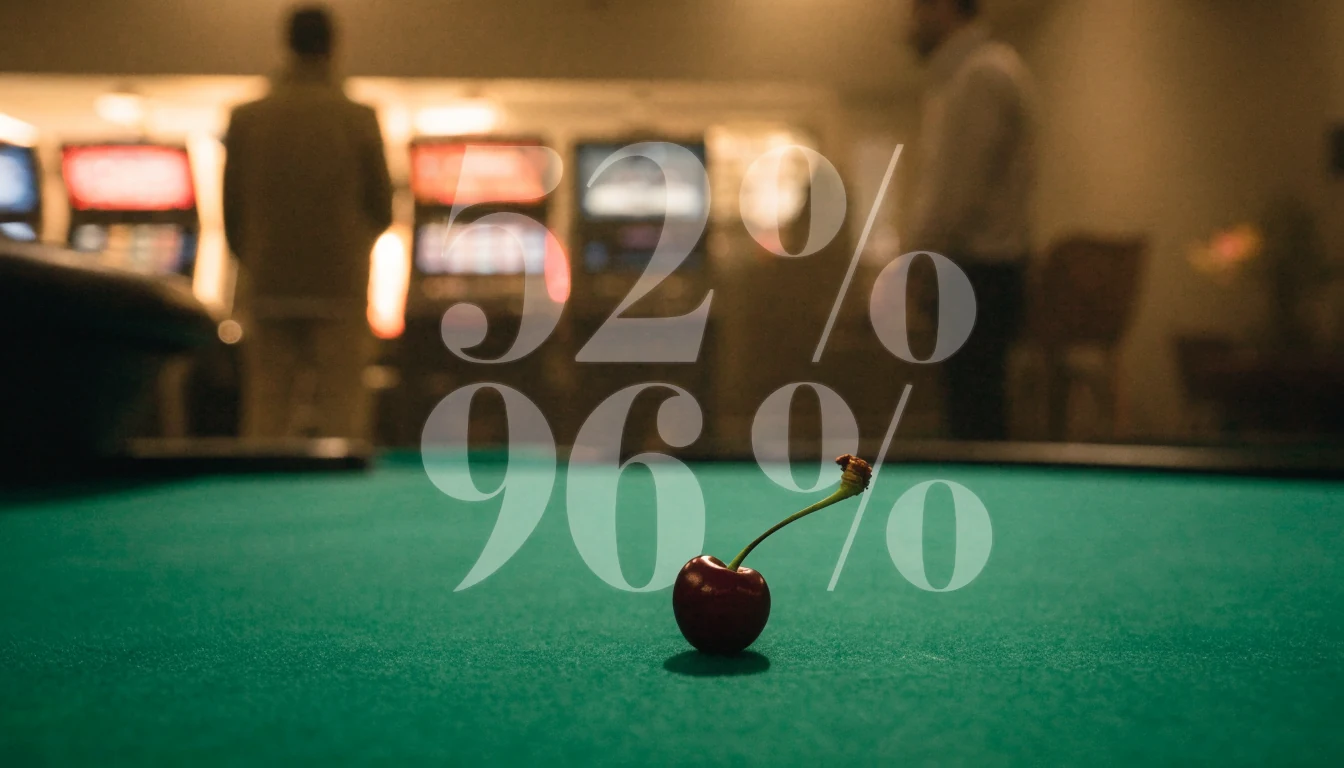
The same specialist review reports a highest return of 96.23% for bets on higher than 4 or lower than 10. That figure belongs to the stated choices in that described game; it should not be carried over to other reels or treated as a general return for live Hi-Lo. A return figure describes a mathematical relationship over play, not what a particular stop will do. The next result remains a win or loss under the game’s own comparison.
After a win, the described format offers a second decision: parlay the original bet and its winnings, or collect and begin again. Parlaying keeps the winnings in play alongside the initial stake, extending the sequence rather than closing it. Collecting ends that run and returns the player to a fresh start. Neither option changes the result already recorded; they determine what happens to the successful wager next.
This choice gives the reel game a rhythm beyond the spin itself. A win does not necessarily end the hand. It can become the starting point for another attempt, or it can be taken off the table. The appeal of continuing is plain enough; so is the danger that an accumulated win can be exposed to another losing stop. The option is not a prediction about the next reel. It is a decision about whether to keep the winnings at risk.
Keep the original bet and its winnings in play to extend the sequence.
End the current run and return to a fresh start with the accumulated winnings.
In that sense, the reel format makes two moments visible: the chosen direction before the stop, and the choice to continue after a win. Its particular tension lies between them. First, the reel decides whether the call was right. Then the player decides whether that success is enough.
When the Deck Remembers
Draw Hi-Lo changes its character because the deck is not reset after each decision. It begins with a single 52-card pack, and aces count as low. Once a card has appeared, it stays out of play for the rest of that game. The same card cannot turn up again.
That removal makes the remaining pack part of the problem. A higher-or-lower choice is not judged against an untouched deck: cards already seen have altered what is left. If several high cards have gone, for instance, the balance of unseen cards differs from the one at the start. A player tracking those changes is doing more than recognising the current card’s rank; the task is to keep an imperfect running picture of the possibilities.
This is the distinction behind card counting in Draw Hi-Lo. Basic strategy responds to the position at hand without keeping a count of removed cards. A card-counting approach uses that history to adjust decisions as the deck thins. Neither method makes the next card certain. It changes the estimate, not the fact that a guess remains a guess.

A specialist review reports a 96.07% return for basic strategy and a 100.36% return for card counting. These figures belong to the particular analysis reported, not to every Hi-Lo game or every way of playing it. The second figure, in particular, should not be read as a promise of profit: a calculated return describes an expected result under stated assumptions, while an individual session can move sharply in either direction.
The deck has a memory, but only in the narrow mathematical sense that its composition changes as cards leave it. The player must supply the rest: attention, a count, and a willingness to accept that information improves a decision without settling it. A small edge on paper.
A Guess, a Pot, and a Pay Table
An online Hi-Lo game reduces a card sequence to a repeated comparison. A card appears, and the player calls whether the next one will rank higher or lower. The question is not about suits or a dealer’s hand; it is about the relative value of two successive cards.
The scale runs from ace, worth one point, through to king, worth thirteen. Each revealed card becomes the reference for the next call. A low card leaves many values above it; a high one leaves fewer. The game’s small arithmetic is visible, but its consequences are not evenly distributed: the apparent simplicity of a choice can conceal how quickly a run of guesses changes the pot.
A wrong guess voids not only the money placed on that specific prediction but also all winnings collected during the game.
A pay table supplies the terms for a successful call. If the prediction is right, the winnings are added to the player’s pot. That makes the pot more than a display of progress: it records the result of the decisions already made. The next card does not merely settle another isolated question; it can determine whether the accumulated game continues to have value.
A wrong call has the opposite effect. The money placed on that guess is lost, and in this game a wrong guess voids the winnings collected during the game as well. The distinction between a correct and incorrect prediction is therefore sharper than a simple adjustment to the balance. One successful call can build the pot, but it does not protect that pot from a later mistake.
The pay table matters because “higher” and “lower” describe the choice, not the return. The amount credited after a correct prediction depends on the stated payout for that outcome. Without that schedule, the direction of a guess can be understood, but the value attached to it cannot. A screen that makes the next card prominent may draw the eye away from the less dramatic line that explains what a correct call earns.
This is the straightforward online form: a visible card, a directional prediction, and a pot that rises after success and disappears after failure. It should not be confused with the separate single-deck Draw Hi-Lo format, whose card-removal rules and stopping choices shape a different discussion. Here, the central bargain is plain. Guess well, and the pot grows; guess wrong, and the game’s accumulated winnings are gone.

The Online Version and Its Limits
An online Hi-Lo game can turn a sequence of card guesses into a small exercise in deciding when a result is enough. In the single-deck version, the first card establishes the reference point. After a decision, the game offers a choice: stop and collect what has accumulated, or continue with another guess. That choice gives the session its shape. The cards set the immediate uncertainty; the player decides whether to carry the winnings back into it.
The deck is described as a single pack of 52 cards, with used cards kept out rather than returned. That matters over the course of a game: the next draw comes from what remains, not from a freshly restored pack. The first decision therefore takes place under different conditions from a later one. As cards disappear, the possible next cards change, even though the game’s basic question remains the same.
There is a conflict in descriptions of the format. One account presents a single 52-card deck with no replacement of used cards; a specialist review describes six 48-card decks with continuous shuffling. Those are materially different arrangements. In the first, the history of the game changes the remaining composition of the deck. In the second, cards are returned through a shuffler, so the same kind of running removal does not define the session. The distinction is not decorative: it affects what “the next card” means.
Deck Variations
Descriptions vary between a single 52-card deck where used cards are kept out and six 48-card decks utilizing a continuous shuffler.
In the single-deck version, a correct guess pays according to the pay table. A tie is a push, rather than a win or a loss, so the decision does not advance the winnings in the same way as a successful call. An incorrect guess loses. More sharply, a wrong call voids all winnings accumulated in that game, not merely the latest gain. The pot is therefore conditional: it exists as a collectable result only while the player stops before a failed prediction.
That creates a particular pressure around continuation. Each successful call can make stopping more attractive, because there is now something to preserve; it can also tempt another turn, since the game allows play to continue. There is no neutral choice between those impulses. Continuing exposes the accumulated result to another possible loss, while stopping closes the sequence and collects the winnings so far. The interface may make that decision look like a simple button press. Its consequence is less simple.
The option to quit after the first decision matters because it keeps the session from being an all-or-nothing commitment at the outset. The game can end with a collected result, or with the accumulated winnings erased by a later incorrect guess. A push interrupts that binary, but does not turn the next choice into a certainty. Nothing in the stop option alters the cards already removed or promises a favourable continuation.
The limit is built into the structure: a growing pot is not secure merely because it has grown. It remains exposed until the game ends by choice. A quiet little trap.
Choosing a Hi-Lo Site Without a Fictional Shortlist
A Hi-Lo game can look simple on screen: a card appears, a direction is chosen, and the next card settles the call. The site behind it is a different matter. Its regulatory standing is not visible in the game’s layout or name. In Great Britain, that standing begins with the Gambling Commission, the body responsible for regulating commercial gambling, including online casinos.
The distinction between the game and the business matters. A site may present Hi-Lo as one of many casino options, but the relevant question is whether the business offering remote gambling to people in Great Britain holds the required Gambling Commission licence. The regulator’s reach does not depend on where the operator keeps its essential equipment. A company cannot place its systems elsewhere and, on that basis alone, escape the rules for serving this market.
The Commission issues operating licences to businesses and personal licences to individuals working in the industry. These are not interchangeable credentials: one concerns the company’s authority to provide gambling, while the other applies to people in relevant roles. The arrangement reflects a particular idea of responsibility. Gambling is not treated simply as a private transaction between a customer and a website; the business, and certain people within it, fall within a public system of oversight.
Great Britain has one regulator for commercial gambling: the UK Gambling Commission. The wider United Kingdom is not governed by one identical legal framework in every respect, so that description should not be stretched beyond its scope. For the purposes of remote gambling offered to consumers in Great Britain, however, the Commission’s role is central. The location of a company’s equipment does not change that.
Check Operator Licence
- Identify the business offering remote gambling
- Locate the Gambling Commission licence number
- Verify the licence on the Commission’s public register
- Confirm the site name corresponds with the registered business
For someone comparing Hi-Lo casino sites in the UK, the useful check is therefore not a decorative seal in a page footer. Before depositing, the licence number should be checked against the Commission’s public register. The name presented on a site and the business named in the register should correspond; otherwise, the badge alone has done little work. The register provides a way to verify the operator’s regulatory footing rather than relying on the operator’s own presentation of it.
This is a modest exercise, not a guarantee about every feature of a game. A licence establishes that the business is operating within the relevant regulatory system; it does not make every Hi-Lo format identical, nor does it turn a particular game into a recommendation. The rules of play still belong to the game, while the licence belongs to the operator. Confusing the two gives a site’s branding more authority than it deserves.
The wording on a site may also blur the difference between a game title, a product provider and the business taking the deposit. Those names can refer to different parts of the arrangement. The practical point remains the same: the company responsible for offering remote gambling to Great Britain consumers is the one whose licence status needs checking. A familiar game label is not a substitute for that check.
There is something revealing in this division of responsibility. The game reduces uncertainty to a choice between higher and lower; regulation refuses that neatness. It attaches duties to a business, and sometimes to individuals, even when the machinery sits beyond the country’s borders. The screen may make gambling feel weightless. The licence is meant to keep the operator’s obligations on the record.
A register check is thus a threshold question, not a verdict on whether a site is enjoyable or whether its version of Hi-Lo suits a particular player. It separates a regulated offer from a claim that merely looks official. That is less glamorous than a ranked shortlist, but more useful: the name of a game can travel freely; the authority to offer it for real money cannot.
What “Best” Can Mean Without a Top Ten
When choosing a UK casino for hi-lo in 2026, payout timing is one practical detail to check alongside the games and terms. This list offers a concise reference to the payout information available for each operator.
Payout speed: 1-3 business days Chanze lists a payout speed of 1–3 business days.
Payout speed: 1-3 business days WinBeast lists a payout speed of 1–3 business days.
Payout speed: 1-3 business days EvoSpin lists a payout speed of 1–3 business days.
Payout speed: 1-3 business days SpinFormula lists a payout speed of 1–3 business days.
Payout speed: 1-3 business days SlotoSport lists a payout speed of 1–3 business days.
Payout speed: 1-3 business days Amunbet lists a payout speed of 1–3 business days.
Payout speed: 1-3 business days BeOnBet lists a payout speed of 1–3 business days.
Payout speed: 1-3 business days Britsino lists a payout speed of 1–3 business days.
Payout speed: 1-3 business days Jetsetspins lists a payout speed of 1–3 business days.
Payout speed: 1-3 business days x3bet lists a payout speed of 1–3 business days.
“Best” sounds like a verdict on a casino, but Hi-Lo offers a narrower and more useful comparison: the payout attached to the choice in front of the player. A site ranking cannot establish that one Higher or Lower decision is better than another. The game’s own displayed terms are the relevant evidence.
For a Higher or Lower bet, the recommended strategy is to select the option that pays more. That is a comparison between the payouts offered for the available choices, not a promise that the more generous figure will make the next card behave kindly. A payout is a price attached to an outcome; it does not turn uncertainty into certainty.
The distinction matters because “best” can blur two separate questions. One is which Hi-Lo game or casino deserves attention; the other is which direction to choose in a particular decision. The second can be assessed from the stated payout choices. The first would require evidence about products and operators that a game decision alone cannot provide. A neat ranking might look decisive. It would not answer the same question.
Recommended Strategy
Identify the available Higher and Lower options and select the one with the higher stated payout.
Payouts also need to be read in context. A figure has meaning only alongside the choice it belongs to and the conditions of that game. Comparing isolated figures from different presentations can create the appearance of a clear winner while leaving out what the figures describe. The sensible comparison is therefore modest: identify the available Higher and Lower options, note what each pays, and favour the one with the higher stated payout, as the recommended strategy advises.
That does not mean every choice has a satisfying answer. A larger payout may make one direction the recommended selection without making it a safe one. Nor does the word “best” settle what a player values: a straightforward decision, a particular pay table, or simply a game whose rules are easy to follow. Those are different preferences, not interchangeable measures of quality.
There is a social habit behind the demand for a single winner. Lists promise to make a crowded market legible: one name at the top, the rest beneath it, the decision apparently completed. But a ranking of casinos cannot replace attention to the actual game. Hi-Lo reduces the question to a small comparison, and that smallness is part of its appeal. The player is not weighing an elaborate set of moves; the stated payouts give a direct basis for choosing between directions.

A careful account of the best Hi-Lo casino, then, should not pretend that a single label resolves every choice. The useful point is what the game says it will pay for the available outcomes. If a presentation does not make those alternatives clear, there is no sound basis for calling one choice superior from the payout alone. If it does, the comparison is plain: take the higher-paying option, while recognising that this is a strategy for making the decision, not a guarantee about its result.
This is not a casino league table in disguise. “Best” here describes a way to compare the game’s stated choices, not an unsupported claim that one operator, or one version of Hi-Lo, outranks all others. The difference is less glamorous than a winner’s podium. It is also more honest.
How to Play: One Decision at a Time
A round begins with a card dealt at random. That card sets the point of comparison: the next decision concerns whether the card to come will rank higher or lower. In the draw-game version, aces count low, and used cards are not put back into the deck.
The practical sequence is simple:
- Look at the starting card and consider the two directions.
- When neither direction is obvious, choose higher or lower.
- Wait for the next card and compare its rank with the one already showing.
- If the call is right, the pay table determines the return. A matching rank is a push; a wrong call loses.
That last outcome is harsher than a single lost wager: a wrong guess voids all winnings collected during that game. The accumulating pot is therefore not quite a stack of secured prizes. It remains exposed while the round continues.
After the first decision, play can stop and the winnings accumulated so far can be collected. Continuing means making another comparison, not merely watching the same choice play out. Each new card changes the position from which the next call is made, while the cards already used remain out of the deck.
This is the whole rhythm of how to play Hi-Lo at an online casino: begin with the random card, make a directional call when the ranking leaves room for judgment, then decide whether to end the run or risk what has built up. A short sequence. No safe streak.
Created by the ”Tenobet Casino 4” editorial team.