Deal or No Deal Casino UK: Game Format and Rules
 Available in GB
The show’s briefcase choices shape the game, while the available facts set limits on what can be said about demos, bonuses and variants.

Table of Contents
- The Briefcase Format Behind the Slot
- How the Online Game Moves from Qualification to the Deal
- The UK Rules Around Playing Online
- What a Free-Play Demo Can—and Cannot—Show
- Golden Box Megaways, Double Action and the Bonus Question
- Free Spins and Box Clever: What the Available Facts Leave Open
- What’s in Your Box? The Show’s Last Briefcase
- A Review Without Inventing Variant Features
- “Perfect Play” and the Limits of Prediction
- Free Online Play and the Stated Return
The Briefcase Format Behind the Slot
The appeal of Deal or No Deal begins with an unusually plain object: a row of closed briefcases. Each conceals a sum of money, but the contestant cannot know which one contains which amount. The show turns that lack of knowledge into its central spectacle. A case is opened, a possibility disappears, and the meaning of every unopened case shifts. Nothing about the briefcase changes. The suspense does.
The format is built around a tension between chance and judgement. Contestants do not simply wait to discover what they have won. They must decide whether to accept the Banker’s offer or continue towards an unknown result. The offer gives uncertainty a visible price. It may be set against the contestant’s own case, against the values still in play, or against the prospect of seeing the game through. The choice is emotional as well as mathematical: the show asks what a person will do when a definite sum competes with an uncertain one.
The structure makes that private calculation public. The game begins with sixteen briefcases. In the opening round, three are opened, then the Banker makes an offer. The host asks the question that gives the programme its name: “Deal or No Deal?” The contestant’s answer is not merely a response to a number. It becomes a performance before the studio, the host and the audience at home, all of whom have watched the same reveal but may read its consequences differently.
If you’re considering a Deal or No Deal casino in the UK in 2026, payout timing is one practical detail to check. This list gives you a quick reference for the stated withdrawal speed at each operator.
Payout speed: 1-3 business days Chanze lists a payout speed of 1–3 business days.
Payout speed: 1-3 business days WinBeast lists a payout speed of 1–3 business days.
Payout speed: 1-3 business days EvoSpin lists a payout speed of 1–3 business days.
Payout speed: 1-3 business days SpinFormula lists a payout speed of 1–3 business days.
Payout speed: 1-3 business days SlotoSport lists a payout speed of 1–3 business days.
Payout speed: 1-3 business days Amunbet lists a payout speed of 1–3 business days.
Payout speed: 1-3 business days BeOnBet lists a payout speed of 1–3 business days.
Payout speed: 1-3 business days Britsino lists a payout speed of 1–3 business days.
Payout speed: 1-3 business days Jetsetspins lists a payout speed of 1–3 business days.
Payout speed: 1-3 business days x3bet lists a payout speed of 1–3 business days.
That shared knowledge is important. The audience can see which values have been removed, yet it cannot see the contents of the cases still closed. Viewers are invited to make predictions without having an advantage over the contestant. Every reveal narrows the field of possibilities while making the remaining uncertainty feel more concentrated. The simple action—open a case—keeps producing new emotional weather.
The Banker is the format’s counterweight. Their offers interrupt the sequence of reveals and turn a game of hidden contents into a negotiation. The contestant has an offer in hand, but not the knowledge needed to judge it with certainty. Accepting ends the suspense in exchange for a known amount; refusing preserves the chance of a different outcome. The Banker is not simply another player at the table. As an unseen presence, they give the contestant someone to answer, even when the real argument is with uncertainty itself.
Before the final stage, contestants receive three offers. Each brings back the same dilemma, but its meaning changes as briefcases are opened and possible outcomes fall away. A sum that once seemed persuasive can look different after a reveal; an offer that appears cautious may seem more attractive when the contestant is visibly reluctant to risk what remains. The repeated question makes the show’s rhythm recognisable. It also prevents the game from becoming a mere sequence of prizes being uncovered. A decision keeps interrupting the arithmetic.
At the end, the contestant can accept the offer, reject it and take the prize in their own briefcase, or switch to the last unopened case. These choices give the close its particular charge. Keeping a case can feel like trust in an earlier decision; switching can feel like a final attempt to escape it. Taking the offer trades the unknown for certainty. None of those responses reveals a guaranteed route to the better result. They reveal a temperament under pressure.

That is why the briefcase works so well as a television prop. It is both container and promise, a physical boundary around information. Its contents remain invisible while the contestant’s reactions are not. The audience watches confidence rise and falter, hears the room respond, and sees how a personal decision changes when it must be made aloud. The show’s suspense is not only about money. It is about the moment a person has to choose with incomplete knowledge while everyone else waits to learn what that choice meant.
The format also travels easily into the language of casino entertainment. A Deal or No Deal slot borrows a familiar dramatic idea: concealed possibilities, reveals and a decision framed against an uncertain outcome. That resemblance explains why searches for a Deal or No Deal slot game often begin with memories of the television show. But the show’s identity lies less in the briefcase as an object than in the pauses around it—the offer, the hesitation, the host’s question, the answer.
The phrase “Deal or No Deal?” sounds like a clean division between two paths. In practice, the drama comes from the fact that neither path is fully knowable at the moment of choice. The audience can calculate what remains, but calculation cannot disclose what is inside the last case. The show makes that limit visible, then asks contestants to act anyway.
A small box. A large pause.
How the Online Game Moves from Qualification to the Deal
The online game does not begin with the Banker. It begins with qualification, a gate that has to open before the Deal or No Deal game itself can be reached. The stated requirement is specific: all three rings must land on a gold slice. Until that happens, the bonus game is not yet in play. The rule gives the opening stage a simple threshold, even if the uncertainty lies in whether the required result will appear.

After qualification, Top Up is available as an optional step. Its stated purpose is to add to prizes. That makes it a choice in the sequence rather than a compulsory part of reaching the main game: qualification comes first, Top Up may follow, and the Deal or No Deal game comes after. The option matters because it sits between entry to the feature and the briefcase decisions that give the game its name. It is not the same decision as accepting a Banker offer later.
Then the bonus game begins. Suitcases are opened in batches, and the Banker makes an offer as the sequence advances. At each offer, the player has a choice: accept the amount or continue. Accepting is decisive. The game ends, and the player collects the offered amount. Continuing leaves the briefcase sequence unresolved and leads towards the next stage of play.
That structure gives the slot game its particular rhythm. An opening stage establishes whether the feature is reached; the optional Top Up sits before the main game; and, once suitcases are being opened, each Banker offer interrupts the reveal with a decision. The offers are not merely commentary on what has happened. They create a point at which the player can stop the sequence in exchange for a stated amount, or decline and allow the game to continue.
There are four Banker offers before the final stage. The offers arrive after batches of suitcases have been opened, rather than after every individual reveal. The player can accept any of them, in which case that game is over and the offered amount is collected, or reject the offer and proceed. The decision is therefore repeated, but its consequence is consistent: taking the Banker’s offer ends the game.
After the fourth offer, a further choice appears. The player can switch the remaining two suitcases before they are opened. It is a switch between the two still in play, made at the last stage of the sequence; it does not undo an earlier offer or restart the feature. The remaining contents are still unknown when that decision is made. A switch changes which suitcase is kept, not the uncertainty that surrounds its contents.
Online Game Sequence
Three rings must land on a gold slice to open the gate to the bonus game.
A player may choose to use Top Up to add to the prizes before the main game begins.
Suitcases are opened in batches, interrupted by four separate Banker offers.
The player can accept the final offer, keep their own briefcase, or switch to the last remaining suitcase.
For anyone looking at a Deal or No Deal slot machine game online, the useful distinction is between the qualification condition and the later choices. The gold-slice requirement determines whether the bonus game is entered. Top Up is optional and comes after qualification. Banker offers belong to the bonus game itself, where accepting ends play and continuing preserves the possibility of reaching later offers and the final suitcase choice. Treating these as one continuous “deal” can blur the separate decisions built into the sequence.
The familiar television premise supplies the vocabulary, but the online game’s stated progression is more compact: qualify, consider Top Up, then face the bonus game. Its tension is organised around interruptions. A batch of reveals is followed by an offer; the offer demands a choice; the fourth offer leads to the possibility of switching the last two suitcases. There is no single decision that settles the whole feature until an offer is accepted or the remaining suitcase choice is made.
That is why the Banker’s role is not simply to announce a value. Each offer changes the player’s immediate options. Accepting converts the offer into the amount collected and closes the game. Continuing keeps the sequence alive, with another batch of opened suitcases and another offer ahead, until the final stage. The format makes stopping part of the play.

The route from qualification to the deal is thus a sequence of gates and choices, not a promise of a particular result. Three rings must meet the gold-slice condition; Top Up may be used to add to prizes; then the bonus game turns each batch of reveals into a fresh decision about whether to take the Banker’s offer or continue. At the end, the two remaining suitcases can be switched before they are opened. The mechanics are plain. The contents are not.
The UK Rules Around Playing Online
A branded online slot does not sit outside gambling law because its theme comes from television. Deal or No Deal online slots are part of the wider remote-gambling market: the rules concern the operator and the service offered, not whether the game borrows its name from a familiar programme.
In Great Britain, the UK Gambling Commission is the sole regulator of commercial gambling. Its remit covers remote gambling offered to consumers there even when the operator’s key equipment is located elsewhere. A business needs an operating licence to provide gambling, while individuals carrying out specified roles in the industry may need personal licences. The distinction matters: the licence belongs to the operator’s legal permission to provide the service, not to an assurance that every game will produce a particular result.
The Gambling Act 2005 provides the principal framework for gambling in England, Wales and Scotland; Northern Ireland is outside that Act’s scope. For online casinos serving customers in Great Britain, physical distance from the operator’s servers does not remove the requirement for a Gambling Commission licence. The regulator’s public register is the place to check an operator’s status, and a licensed gambling website or app must display its licence details and link to the relevant register information.
Licensing Check
Online gambling is legal in the UK only through licensed and regulated sites; always verify an operator’s status via the UK Gambling Commission public register before depositing.
That check is more than a badge on a page. A casino’s appearance, familiar title or polished presentation does not establish that it is authorised to serve British customers. Online gambling is legal in the UK only through licensed and regulated sites, and the operator must verify a customer’s age before allowing a deposit. Gambling online is for adults aged 18 and over, subject to the operator holding the appropriate UK licence. The ceremony of a logo is easy; regulatory permission is less decorative.
Protections built into the service
Licensed operators have obligations that shape the account as well as the games. A new customer must be prompted to set a financial limit before making a first deposit, and account-level limit controls must remain accessible. These measures place some friction before play begins, where it can still affect a decision, rather than leaving every safeguard to a moment of regret.
The rules also constrain how online slots operate. Autoplay is prohibited in Britain, and at least 2.5 seconds must pass from the start of one game cycle before another can begin. The maximum stake in an online slot game cycle is £2 for customers aged 18 to 24 and £5 for those aged 25 or older. The £5 limit for all adults aged 25 and above took effect on 9 April 2025. These are regulatory limits, not suggestions displayed in small print.
Payment rules are similarly specific. UK-licensed casinos cannot accept credit cards for gambling, including where a credit-card payment is routed through a money service business. Nor may an operator accept a wallet payment if that wallet allows credit-card funds to be used for gambling. A payment method’s familiar name does not settle the question; the relevant point is whether credit is funding the gambling transaction.

A licensed operator must provide an internal process for complaints and access to an approved Alternative Dispute Resolution service. It must also offer responsible-gambling tools, including self-exclusion. Operators are required to contribute to the Research, Education and Treatment levy. These duties form part of the regulatory framework around the service, rather than optional signs of good manners.
For a player considering an online casino Deal or No Deal title, the practical distinction is therefore not between one slot label and another. It is between a licensed service subject to British requirements and one outside that system. Checking the UK Gambling Commission register before depositing can establish whether the operator is authorised; the licence details on its site should lead to the corresponding public information. That does not turn gambling into a risk-free activity, but it identifies the rules the operator is required to follow.
The rules are not a promise of profit. They establish who may offer gambling, what protections and limits must surround it, and where complaints can be taken if the operator’s conduct is disputed. In a market built around chance, that is a modest but consequential form of order.
What a Free-Play Demo Can—and Cannot—Show
A free-play version can be useful as a viewing window: it may let a player inspect the presentation, read the on-screen information and see how the game behaves without staking money. But the word “demo” describes a mode of access, not proof that every version is available to try without payment. Availability depends on the listing, and a free-play label should not be mistaken for a promise about what that version contains.
Attention: A free-play demo is a tool for inspecting the interface and rules, but it cannot forecast future results or guarantee that a paid version will behave identically.
The distinction matters because familiarity can feel like evidence. A few rounds may make a game’s symbols, sounds and decision points easier to recognise. They cannot establish what a later paid session will return. Nor does a short run of results reveal a dependable pattern. Random outcomes remain random; a sequence that feels unusually generous or barren does not turn into a forecast.
There is one numerical detail worth reading with care. A specialist affiliate review reports that the game’s help files state an expected return of 95.42%. That is a theoretical figure describing a long-run relationship between stakes and returns, not a forecast for an individual session. It does not mean that a player will receive that share back, or that any particular stretch of play will resemble the stated percentage. Expected return is a property of the game’s model, not a receipt.
A demo can help establish whether the displayed rules are intelligible and whether the format is appealing before money is involved. It may also make it easier to notice how choices are presented. Those are modest but real uses. What it cannot do is convert an expected return into a personal expectation, certify the fairness of a particular site, or settle whether a paid version behaves identically. Such conclusions require evidence beyond a few free rounds.
The same caution applies when a free version is labelled with a variation or a different title. A name alone does not establish that the demo and paid game share the same rules, return or features. The listing and the game’s own help information are the relevant places to check what is actually being offered; where those details are absent, a familiar title cannot fill the gap.
Free play also says nothing by itself about promotional terms attached to depositing or wagering. A demo is not a bonus offer, and its availability should not be read as evidence of any particular deposit condition or reward. Those are separate matters, with their own terms.

The sensible use of a demo is therefore narrow: learn the interface, inspect the information presented and decide whether the format is worth further attention. It is not a test that can prove a game is due to pay, nor a rehearsal that guarantees the paid experience will match it. A screen can teach its own language. It cannot disclose the next result.
Golden Box Megaways, Double Action and the Bonus Question
Names such as Golden Box Megaways and Double Action suggest distinct editions of Deal or No Deal, but a title is not a feature list. Treating the labels as proof of extra rounds, altered reels or special prizes would turn inference into product information.
That distinction matters because familiar television branding can make a title feel self-explanatory. “Megaways” may sound like a promise about changing combinations; “Double Action” implies a second layer of activity. Neither phrase, on its own, confirms what happens in a specific game.
The same caution applies to casino listings. A game name may appear in a catalogue, but that does not establish that every casino offers it, or that listings with similar names refer to the same product. The wording can point to what someone hopes to find; it cannot settle the game’s identity.
The bonus question requires a separate distinction. A no-deposit bonus is a promotional offer, not a characteristic of a slot title. Searching for a Deal or No Deal casino offer of that kind does not establish that one is available, who could claim it, or what conditions would apply.
Promotions are attached to operators and can change independently of a game’s name. That makes a phrase such as “Deal or No Deal bonus” an unreliable substitute for an actual offer’s published terms. A branded title and a promotional label may sit beside one another on a page, but proximity is not proof that the game carries the offer.

There is no useful comparison to manufacture from suggestive names. Golden Box Megaways and Double Action can be identified as titles people look for; their mechanics and distinguishing features remain unconfirmed. Likewise, a no-deposit promotion should not be treated as a standing part of either game. The plain description is less theatrical than the branding. It is also more honest.
Free Spins and Box Clever: What the Available Facts Leave Open
Free spins sound like a neat bridge between a familiar title and a promotional offer. In practice, the name alone cannot establish what a promotion includes, which version of a game it applies to, or what conditions attach to it. Those details belong to the offer itself, not to the phrase “free spins”. Without published terms from the operator, there is no sound basis for describing a typical package or implying that one is available.
The distinction matters because a free spin is not simply a game played without cost in every relevant sense. An offer may have rules governing eligibility, use and any resulting prize. Those rules need to be stated by the operator; the label cannot stand in for them.
Box Clever presents a different ambiguity. It appears in searches alongside Deal or No Deal, but a shared search phrase does not explain whether Box Clever is a separate title, a feature, or a promotional name. Nor does it establish how any supposed version plays. Treating the wording as proof of a specific slot mechanic would turn an association into an assertion.
That restraint is less exciting than a list of features. It is also more useful. A game title, a promotion and a feature are different things, even when the same words gather around them online. Unless an operator describes Box Clever in its own game information, claims about its rules or relationship to Deal or No Deal remain speculation.
The known online game sequence includes qualification, an optional Top Up stage and then the Deal or No Deal game. That outline does not identify free spins or Box Clever as part of it. The two ideas should therefore not be folded into the game’s stated mechanics.
Names travel quickly. Terms do not.
- Rely on the operator’s published terms for promotion details
- Use game help files to check stated return percentages
- Verify the same rules apply to both demo and paid versions
- Assume a game title proves the existence of specific features
- Treat a free spin label as a guarantee of a specific package
- Use demo results to predict patterns in real-money play
What’s in Your Box? The Show’s Last Briefcase
The question of what is in the contestant’s box is the game’s simplest mystery and its most stubborn one: until it is opened, the prize remains hidden. In the television format, contestants predict whether the money in the last of the 16 briefcases to be opened will be greater than the Banker’s offer. The suspense rests not on a clue, but on the gap between an unknown amount and a known proposal.
At the final stage, the contestant has three choices. They can accept the Banker’s offer and leave the briefcase unopened. They can reject it and take the prize in their own briefcase. Or they can switch to the last unopened briefcase, making the hidden contents elsewhere the prize at stake.
That choice gives “What’s in Your Box?” its dramatic force. The box is not merely a container; it becomes a claim about judgement. Keeping it suggests confidence in the selection already made. Switching means abandoning that claim for another unknown. Taking the offer turns away from both possibilities in favour of a definite amount.
The show does not make the uncertainty disappear. It stages it, then asks the contestant to act while it remains. The Banker’s offer gives the hidden prize a point of comparison, but it does not reveal what the briefcase contains. The final decision is therefore a contest between the value offered and the chance that the unopened case holds more—or less.
This is the television format’s final dilemma, not evidence of a particular slot feature. A slot title referring to “What’s in Your Box?” does not, by itself, establish that the game reproduces the show’s last choice, or that it has a particular return. The show’s format can explain the phrase’s appeal; it cannot supply specifications for an online game.
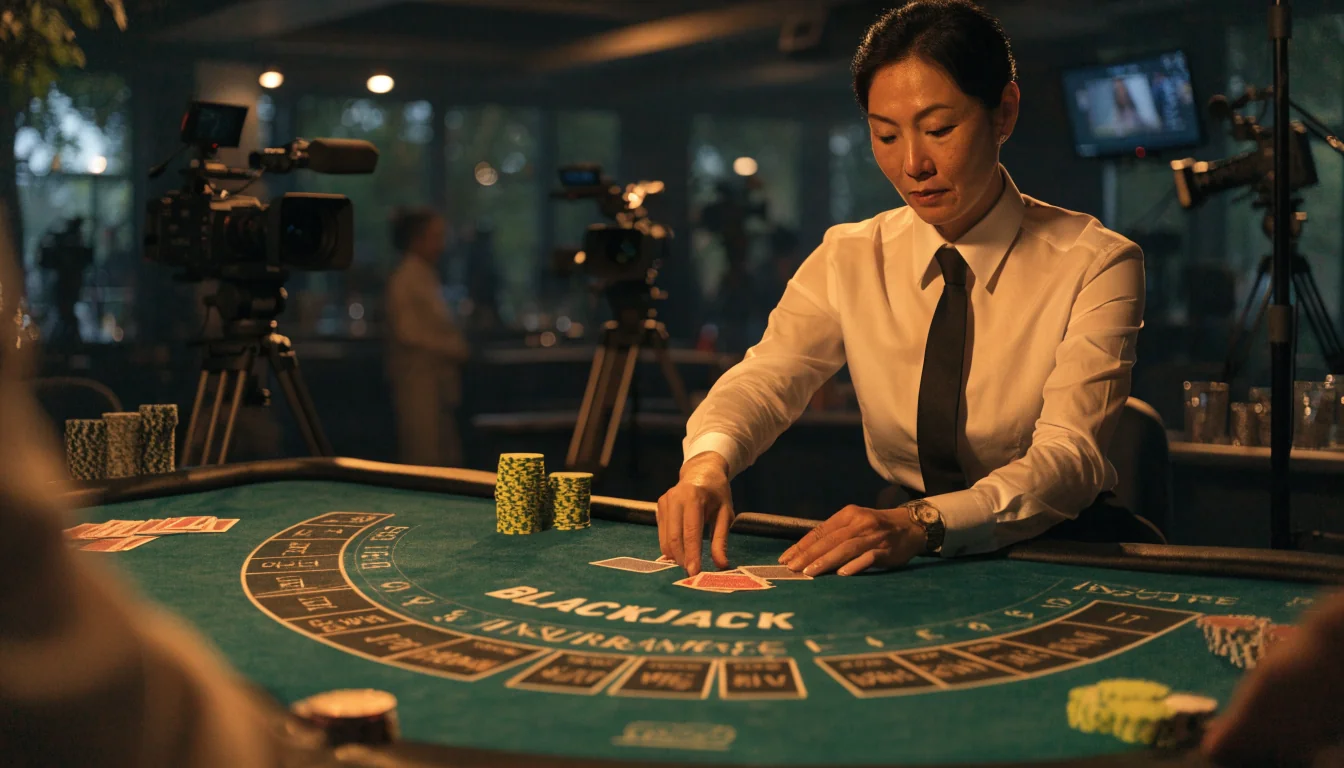
The last briefcase keeps its answer until the reveal. That is the point. No clever reading of the contestant’s choice can make the contents known in advance, and the decision carries its meaning precisely because certainty arrives too late to guide it.
A Review Without Inventing Variant Features
A review of Deal or No Deal Double Action can sound more definite than its evidence allows. The name invites assumptions: perhaps “Double Action” signals an extra feature, a different pace or a revised way to play. But a title alone cannot establish what changes inside a game, and a confident verdict built on that assumption would be decoration, not analysis.
The same restraint applies to Deal or No Deal What’s in Your Box. Its wording recalls the television show’s final briefcase choice, but that association does not establish how a slot bearing the name works. A review should not turn a familiar phrase into a promise about gameplay. That is where the neatness ends.
One numerical point can be stated with care. An affiliate review says the game’s help files give an expected return of 95.42%. That figure describes an expectation, not a prediction of what an individual session will return. Nor does it, by itself, distinguish one named version from another. A percentage can look like a verdict because it is precise; precision is not the same as breadth of evidence.
The useful question is therefore not whether either title is “better” on the strength of its name. It is what a particular review actually establishes: whether it identifies the game being assessed, reports a measurable detail with a clear basis, and separates that detail from impression. Without that separation, a review can make a variation sound documented when only the label is doing the work.

There is no need to manufacture a ranking to make the comparison useful. Double Action and What’s in Your Box can be treated as distinct review subjects, while the stated return remains a single reported figure rather than a verdict on either title. Names attract certainty. Evidence earns it.
“Perfect Play” and the Limits of Prediction
“Perfect play” sounds like a promise that uncertainty can be solved by choosing correctly. In Deal or No Deal, the phrase meets a less obedient reality: the contestant is asked to judge an offer against a prize concealed in a briefcase. The decision can be reasoned through, but the contents remain unknown until revealed.
The television format makes that tension explicit. Contestants begin with 16 briefcases, and the central prediction concerns whether the amount in the last one to be opened will exceed the Banker’s offer. Before the final stage, three offers arrive, each accompanied by the host’s question: “Deal or No Deal?” The ritual gives a private calculation a public form. A pause, a family discussion and a decision become part of the entertainment.
There is no single answer that can be called perfect without knowing what is inside the unopened briefcase. Accepting an offer fixes the amount won at that offer; rejecting it leaves the contestant with the prize in their own case, while switching means taking the last unopened one instead. These are different choices under uncertainty, not a method for making uncertainty disappear.
The Banker’s offer is therefore more than a number to beat. It is a proposed settlement: a known amount set against an unknown one. A contestant may weigh the offer against the possibility of a larger prize, or against the prospect of ending with less. The show makes that comparison legible, then leaves the consequence to chance.

That distinction matters when “perfect play” is attached to a slot search. The phrase may suggest a strategy that guarantees a better outcome, but the show’s decision format does not establish such a strategy for a particular online game. Its drama comes from incomplete information, not from a secret sequence of choices that can reveal the briefcase’s contents.
A decision can be deliberate. The result remains uncertain.
Free Online Play and the Stated Return
The idea of playing a Deal or No Deal slot online without paying has an obvious appeal: it seems to offer the spectacle without the financial stake. But “free online play” can describe different things, and the phrase alone does not establish that a particular version is available at no cost or that its features match a paid game.
One measurable detail is reported in a specialist review: the game’s help files state an expected return of 95.42%. That is a theoretical figure describing the game across play, not a forecast for an individual session. It does not say what a particular player will receive, nor turn an uncertain result into a predictable one. A percentage can look like a promise when set apart from its context. It is not one.
The distinction matters especially when free access is being considered as a guide to real-money play. A figure quoted from help files is information about the game’s stated design; it does not, on its own, confirm the terms of a free version, its availability, or whether every version uses the same settings. Those details should not be inferred from the word “free”.
The title’s appeal rests on suspense: a sequence of decisions held open until an offer or a prize settles the question. Free access, where offered, changes the cost of taking part, not the uncertainty that gives the format its shape. The return figure belongs to that distinction: a property of the game as described, not a personal outcome. No guarantee.
Written by the editors at Tenobet Casino 4.