Casinos That Accept E-Wallets in the UK
 Available in GB
E-wallets add a payment intermediary, so acceptance, deposit limits and withdrawal routes can affect how casino transactions work.

Table of Contents
- How E-Wallets Fit into UK Casino Payments
- What Makes an E-Wallet Option Worth Considering
- Depositing with an E-Wallet: Limits and First Checks
- What ‘Accepted’ Means in 2026
- Why Withdrawals Usually Follow the Deposit Route
- Checking Whether a Wallet Works Both Ways
- Skrill, Neteller, Payz and Other Wallet Names
- Payment Choices for UK Players
- Where to Confirm a Site’s Payment Options
- Payment Ownership, Verification and Avoidable Friction
How E-Wallets Fit into UK Casino Payments
Casino payments in Britain are not a single system with several decorative buttons. They are a set of routes between a player’s money, a payment provider and a gambling account, each with its own role. Debit cards, bank transfers, e-wallets and prepaid vouchers can all appear in the same cashier, but they do not do the same job. The choice is less a contest than a question of what kind of payment is being made.
Debit cards remain a familiar route. UK casinos commonly accept Visa and Mastercard debit cards, which connect a transaction to a bank account through a card network. Their familiarity is part of their appeal: the card is already part of ordinary household spending, so a casino payment may feel like an extension of an existing habit. That ease should not blur the distinction between debit and credit. Credit-card payments for gambling are banned in the UK, and the restriction also covers credit-card funds routed through a money service business. A payment screen is not an invitation to treat every card product alike.
An e-wallet adds an intermediary. Rather than sending funds directly from a bank account or card to a gambling account, the customer uses a separate payment account, which may itself be funded through an eligible source. That extra step can make the wallet feel like a distinct spending compartment: money is moved into the wallet, then used for a payment elsewhere. It can also make the transaction less transparent at a glance, because the visible casino payment and the original source of the funds are not necessarily the same thing.

That separation is practical, but not absolute. UK rules prevent remote gambling operators from accepting wallet payments when the wallet permits credit-card funds to be used for gambling. The point is not merely which logo appears in a cashier. The funding route matters too. A wallet is not a way to turn a prohibited credit-card payment into an acceptable one by passing it through another account. Financial systems, it turns out, are not fooled by an extra screen.
E-wallets sit between cards and bank transfers in the public imagination: more specialised than a bank card, less directly tied to a bank transfer, and built around an account with a payment provider. Skrill and Neteller are examples available at some casino sites. A specialist review has reported that these wallets are often excluded from promotions, a condition that can change between operators and offers. Their presence therefore says something about payment access, not necessarily about whether a particular bonus can be used alongside them. The two questions belong on separate lines.
Bank transfers and open banking provide another route, linking payments more directly with a bank account. A specialist review has described these methods as capable of supporting instant deposits and fast withdrawals at many sites. That is a report about the possibilities noted in such coverage, not a promise that every transaction will move at the same pace. Bank-linked payments can look simple because the money begins and ends within familiar financial institutions; the machinery behind them is less visible, and availability can depend on the route offered.
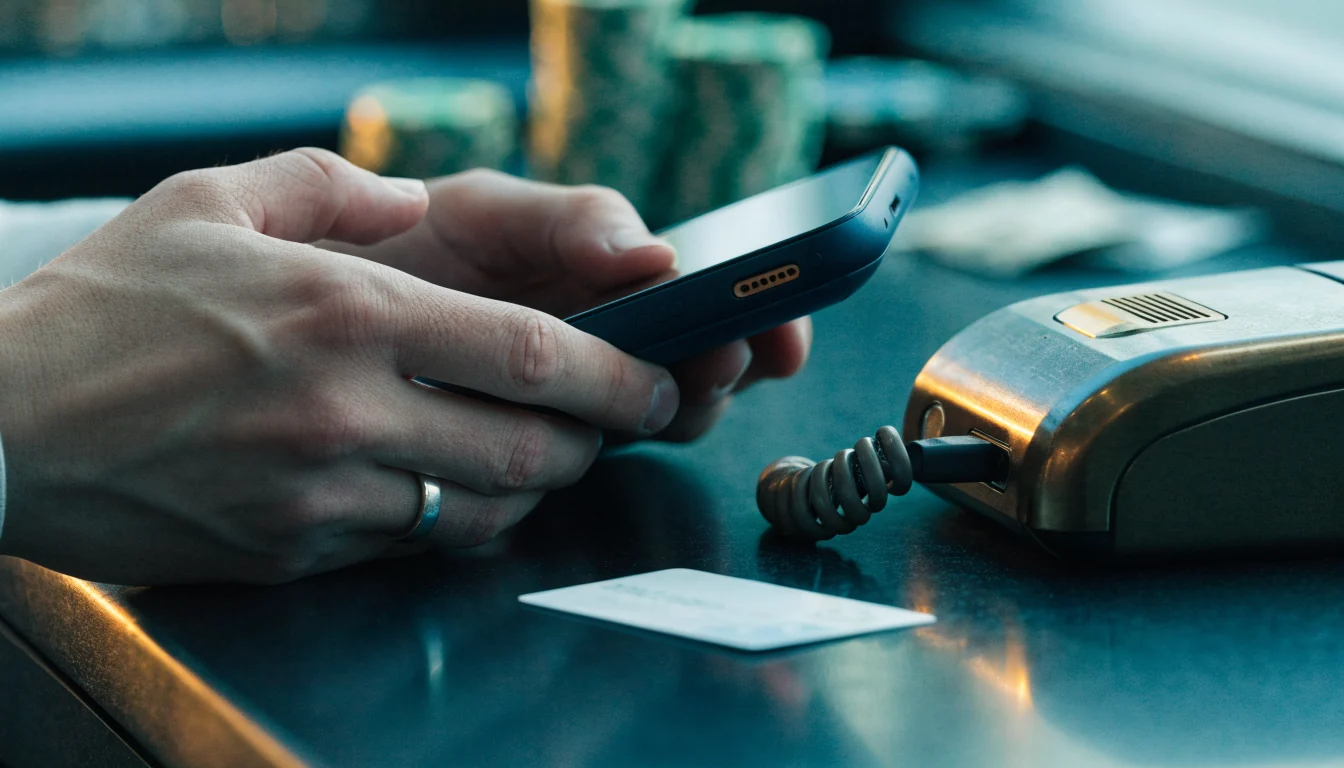
Prepaid vouchers occupy a narrower place. Paysafecard is a voucher used for deposits only. That makes it unlike an account-based wallet that may be presented as part of a broader payment arrangement. The voucher offers a defined use: it can put money into a gambling account, but it is not a route for receiving a casino payout. It is a useful reminder that payment methods are not interchangeable just because they appear under the same cashier heading.
This is the wider setting for e-wallet online casinos in the UK: wallets are one part of a payment landscape that also includes debit cards, bank-linked services and deposit-only vouchers. Each route carries a different relationship to the original funds and to the destination account. The labels in a payment menu can make those distinctions look tidy; the actual transaction depends on the provider’s rules and the casino’s available options.
There is also a social history in the architecture. Cards and bank accounts belong to institutions that have long organised everyday commerce. E-wallets emerged as a layer for moving money across services without making every payment feel like a direct bank transaction. Their appeal is partly technical and partly cultural: a separate account can seem like a boundary between spending worlds. Yet gambling payments remain subject to the same financial controls as other regulated transactions, and an intermediary does not erase those controls.
Credit Card Ban
Credit-card payments for gambling are banned in the UK, including funds routed through money service businesses or wallets that permit credit-card funding.
So, can an e-wallet be used for online casino payments in Britain? Some sites offer wallet options, but the presence of a wallet in the broader market does not make it universal, nor does it settle the terms attached to a particular payment. The more useful starting point is to see the wallet as one route among several, with a specific function rather than a special exemption. No magic door.
What Makes an E-Wallet Option Worth Considering
An e-wallet’s appeal is not a single property. A payment route can feel quick at the point of deposit, yet prove less attractive once promotional terms or charges are taken into account. The useful comparison is therefore not between labels such as “fast” and “slow”, but between what a method offers and what it costs in the circumstances in which it will be used.
Speed has an obvious pull. A specialist casino review describes PayPal as popular for speed and convenience, but that is a reported assessment, not a promise about every transaction or account. Nor does a quick payment step settle the wider question of value. A method may reduce the effort involved in moving money while offering no particular advantage once the casino’s own handling, the wallet provider’s processes and the player’s intended use are considered. Convenience is real; it is simply not the whole calculation.
Promotions can change that calculation. The same specialist review notes that PayPal may be excluded from bonus eligibility. That possibility matters because the value of an offer depends on its terms, not merely on its headline. If a promotion excludes a particular payment method, choosing that method may mean forgoing the offer. If the promotion is irrelevant, or the wallet’s other advantages matter more, the exclusion may make little practical difference. There is no universal answer: the terms attached to the specific offer determine whether the trade-off is meaningful.

Skrill and Neteller are also described in specialist casino reviews as payment methods that can be excluded from promotions. That should be treated as a reason to inspect the terms, not as a fixed rule about every offer or every site. A wallet’s reputation cannot substitute for the conditions attached to a promotion. Payment method, offer eligibility and the player’s own priorities meet in the small print.
Then there is cost, which is rarely as simple as a visible charge. A specialist payment-cost review identifies several possible components: fees charged by the casino, the payment provider, an issuer or bank, and, where relevant, currency conversion or network use. These costs may arise at different points, so a fee shown on one screen does not necessarily represent the full expense of a transaction. A route that appears free at the casino end may still carry a cost elsewhere.
Currency conversion deserves particular attention because its price may be built into the exchange rate rather than displayed as a separate fee. A specialist review notes that the conversion spread can exceed a visible flat charge. That is not an argument that conversion will always be more expensive; it is a reminder that a clean-looking fee line tells only part of the story. When the account, wallet or payment route involves different currencies, the rate used can matter as much as an explicit charge.
Currency Conversion
Conversion spreads can exceed visible flat charges; costs may be built into the exchange rate rather than displayed as a separate fee.
The practical comparison is tied to the amount being moved. A fixed charge and a percentage-based cost do not affect every transaction in the same way, while a conversion spread or network fee may alter the total again. For that reason, there is no single payment method that can be called the cheapest in all circumstances. A meaningful comparison brings together casino charges, provider fees, issuer or bank costs, the exchange rate and any network cost for the transaction at hand.
This is less glamorous than choosing by speed. It is also more useful. A wallet that is convenient and eligible for a desired promotion may still be a poor fit if its total cost is high; another may have no special promotional appeal but suit the intended use better. The balance depends on which feature matters and what the terms actually say.
The choice is not a beauty contest. A payment method earns its place through the combined effect of time, eligibility and expense—not through a single attractive label.
Depositing with an E-Wallet: Limits and First Checks
A wallet deposit may look like a simple transfer from one balance to another, but the amount accepted at the casino end is not necessarily the amount available in the wallet. Each payment route can have its own minimum and maximum, while the account itself may also be subject to limits. The figures shown at the point of payment matter more than a general description of a site’s payment facilities.

A specialist review gives a typical starting minimum of £10–£20, with the exact figure depending on the payment method. That is a guide reported by a review, not a fixed threshold across UK casinos. The minimum displayed for a particular wallet may differ from the figure shown for another route, and the amount can also be affected by the casino’s rules for that account. A deposit below the stated minimum may simply be rejected; one above the permitted maximum may need to be reduced or divided into separate transactions, if the site allows that.
Maximums require a little more attention because they may apply on different timescales. A limit can be set per transaction, across a day, or across a month. A specialist review notes that these ceilings vary by payment method and account status. An account’s position can therefore matter alongside the wallet chosen. There is no reliable single maximum that describes every payment route or every customer, and a figure found in general information may not reflect the limit currently presented to an individual account.
The cashier is the practical checkpoint before a deposit is submitted. Selecting a method should reveal the amount the site will accept for that transaction, and can expose restrictions that are easy to miss in broad payment descriptions. The minimum and maximum need to be read together: a wallet might permit a transfer in principle while the amount intended does not fit the casino’s range. Payment screens are less decorative than promotional pages. They have to process the money.
First Deposit Check
- Confirm the account currency
- Read the selected method’s minimum deposit
- Read the selected method’s maximum deposit
- Ensure the amount fits within account limit controls
Currency is another first check. Specialist review pages report that GBP is supported, but the account currency still needs confirming before the first transaction. If the casino account is set to a different currency from the wallet balance or funding source, conversion may take place. That can change the amount credited, so the figure entered at the payment stage should not be assumed to equal the amount ultimately shown in the casino balance. The account’s currency setting is therefore part of the deposit calculation, not a minor preference to revisit later.
There is also a regulatory step before money reaches the account. Remote gambling operators must verify a customer’s age before allowing a deposit, and UKGC rules require a prompt for new customers to set a financial limit before their first deposit. Account-level limit controls must remain accessible. These safeguards place a boundary around the act of paying: a payment method being available does not bypass the checks or controls attached to a gambling account.
A useful first-deposit check is consequently quite plain: confirm the account currency, read the selected method’s displayed minimum and maximum, and make sure the amount fits within both the payment and account controls. The precise ceiling may be individual; the displayed terms are the relevant ones. Where the intended amount falls outside them, changing the amount is safer than assuming a different limit applies.
The distinction is small on screen and substantial in practice. A wallet balance, casino balance and account limit are separate things, even when a deposit form presents them as one transaction. The form is the final word on what it will accept at that moment.
What ‘Accepted’ Means in 2026
Choosing a UK casino that accepts e-wallets means checking not only payment options but also how long withdrawals may take. Use this list as a starting point, and confirm the available e-wallets and terms directly with each casino.
Payout speed: 1-3 business days Chanze lists a payout speed of 1–3 business days.
Payout speed: 1-3 business days WinBeast lists a payout speed of 1–3 business days.
Payout speed: 1-3 business days EvoSpin lists a payout speed of 1–3 business days.
Payout speed: 1-3 business days SpinFormula lists a payout speed of 1–3 business days.
Payout speed: 1-3 business days SlotoSport lists a payout speed of 1–3 business days.
Payout speed: 1-3 business days Amunbet lists a payout speed of 1–3 business days.
Payout speed: 1-3 business days BeOnBet lists a payout speed of 1–3 business days.
Payout speed: 1-3 business days Britsino lists a payout speed of 1–3 business days.
Payout speed: 1-3 business days Jetsetspins lists a payout speed of 1–3 business days.
Payout speed: 1-3 business days x3bet lists a payout speed of 1–3 business days.
A payment method can appear on a casino’s general information page without being available to every UK customer who visits it. “Accepted” is therefore a narrower claim than it first appears: it may describe a method the site supports in some circumstances, not a universal option guaranteed to appear for every account. A logo is evidence of a relationship, not a promise of access.
That distinction matters when comparing casinos that accept e-wallets in the UK. Payment pages and review summaries can be useful starting points, but they do not settle whether a particular wallet is currently offered to a particular customer. Nor does a broad reference to e-wallets reveal which services are included. The category is not a single payment product; a site’s general wording can leave the practical meaning unresolved.
A specialist review of casino payment options describes the websites it examined as listing Visa, Mastercard, bank transfer, e-wallets and several cryptocurrencies. That is a report about those reviewed websites, not a statement that every UK casino offers every method, or that the same choices remain available across all accounts. Payment information changes; an older summary may preserve what was once listed after the live offering has shifted. The small print of a general page can have a long memory.
The same caution applies to familiar card brands. A specialist review may report Visa and Mastercard among the methods listed by the sites it assessed, but that alone does not establish current UK availability or whether a particular card product is eligible. Those details need confirmation in the site’s cashier. This is not a technicality: credit-card payments for gambling are prohibited at UK-licensed casinos, so a brand name cannot be read as permission for every product bearing it.
Attention A logo on a general information page is evidence of a relationship, not a guarantee that the payment method is currently available for your specific account.
In Britain, remote gambling licensees must hold the relevant Gambling Commission licence to serve customers legally. That regulatory boundary does not make every payment option uniform across the market. A licence governs the operator’s authority to offer gambling; it does not turn a payment list into a guarantee that each method is present, usable or unchanged for every customer. “Licensed” and “available” answer different questions.
The word “accepted” can also blur the difference between a site’s general capability and a current, account-specific choice. A method may be mentioned in broad payment information while the cashier presents a different set of options. This does not make the general page meaningless; it makes its scope important. It describes a published claim, not necessarily the live menu.
For anyone comparing UK casinos that accept e-wallets, the useful question is not simply whether a wallet name appears somewhere on a site. It is whether the site’s current information supports that claim for its UK service. A list copied into a review, a collection of logos in a footer and a live payment screen are not equivalent forms of evidence. One is a summary; another is decoration; the last is the site’s present account-facing information.
That is why “best” or “top” can be a misleading label when the underlying acceptance has not been established. A ranking cannot make a method universally available, and a prominent wallet logo cannot answer what the live service offers. In 2026, the phrase “casinos that accept e-wallets” should be read as a starting description, not a blanket guarantee. Presence on a page is not presence in every account.

Why Withdrawals Usually Follow the Deposit Route
A deposit and a withdrawal may look like opposite movements, but they are not always treated as interchangeable transactions. In the UK, anti-money laundering rules commonly require casino payouts to go back to the original payment source. The route is part of the record: money entering through one channel is expected to leave through that channel, rather than being redirected wherever a customer happens to prefer.
This is often called a closed-loop approach. It gives the payment trail a certain continuity, making it easier to establish where funds came from and where they went. In that sense, the rule is less about the convenience of a particular wallet and more about the purpose of the transaction controls around it. A casino site that accepts e-wallet deposits may therefore treat the wallet used to fund an account as the first route to consider when paying out.
That can matter when a player has used more than one payment method. A card may have funded one deposit and an e-wallet another; the cashier’s records, rather than a general preference for one method, can shape how the payout is handled. The original source is not simply a detail on a receipt. It can determine the permitted destination for funds.
There are practical limits to the neatness of this arrangement. A payment source may no longer be usable, or a transaction may not be eligible to return through the route that was used to deposit. In such cases, an alternative destination is not necessarily impossible, but it can call for further checks. Those checks help establish that the change does not obscure ownership or interrupt the money trail.
Closed-loop payouts
Anti-money laundering rules commonly require payouts to return to the original payment source. If a different route is requested, the casino may conduct further checks to ensure the money trail is not obscured.
This is why a different payout route should not be assumed to be a matter of selecting another button. The casino may need to review the circumstances and confirm the proposed destination before releasing funds. The extra scrutiny is a control, not evidence that a wallet payment has failed. It reflects the difference between sending money along an established route and changing its destination.
For people comparing casino sites that accept e-wallet deposits in the UK, the relevant point is not simply whether a wallet appears in the deposit menu. The withdrawal route also matters, because closed-loop rules can shape what happens after a balance is ready to leave the account. A payment method can be familiar at the point of entry while the route back remains subject to the operator’s checks.
Money remembers its way in.
Checking Whether a Wallet Works Both Ways
A wallet shown beside the deposit button is not necessarily a complete payment route. A casino may display a method for adding funds without offering it for cash-outs, or may make its availability dependent on the account. The useful check is therefore not simply whether the wallet appears somewhere on the site, but whether the cashier presents it for both directions of travel.
This distinction matters because “accepted” can describe only one part of a transaction. A deposit option confirms that funds can be sent into the gambling account; it does not, by itself, confirm that winnings can be sent back to that wallet. Before relying on a wallet as the main route, its withdrawal availability needs to be checked separately. A name on a general payments page is less informative than the options attached to the account’s own deposit and withdrawal screens.

Timing requires the same separation. A withdrawal does not move at a single speed from request to arrival. The casino first has to review and approve it; after that, the payment method has its own delivery process. A specialist review identifies internal approval and account verification as factors in withdrawal speed, and notes that a first withdrawal can take longer while checks are completed. That is a reported description, not a timetable that applies to every casino or wallet.
A displayed processing estimate can therefore refer to only one stage, or combine stages without making the distinction clear. “Pending” may mean the casino has not yet approved the request; “processed” may mean it has released the payment, not that the wallet balance has already changed. The labels vary, so the status wording and any explanation beside it matter more than a bare promise of speed. Two clocks, not one.
The practical test is to look for the wallet in both cashier flows and read the terms attached to each. If it appears for deposits but not withdrawals, it is not a two-way option for that account. If a withdrawal route is listed, the casino’s approval time and the provider’s transfer time still remain separate parts of the wait. Neither should be mistaken for the other.
This check is especially useful where payment pages describe several methods together. A broad list may establish that a wallet is mentioned, but not that it can handle both deposits and withdrawals for every customer. The account-level cashier is the more relevant evidence of what is available at the point of use; even then, the stated timing should be read as a process with stages, not a single guaranteed arrival time.
- Check both deposit and withdrawal screens
- Distinguish between casino approval and provider delivery time
- Verify account ownership matches the wallet name
- Assume a deposit-only wallet allows cash-outs
- Mistake a “processed” status for immediate balance arrival
- Rely on general payment pages instead of the live cashier
Skrill, Neteller, Payz and Other Wallet Names
Skrill and Neteller are familiar names in the UK casino payment landscape, but their presence is not universal. Both appear at some sites; neither should be treated as a standard feature of every account. A specialist casino review describes Skrill as one of the more common deposit methods at UK-friendly sites in 2026, while that description is a snapshot of a changing market, not a promise of availability.
Promotion terms add a separate complication. A specialist casino review reports that Skrill and Neteller are often excluded from promotions. That does not establish a blanket rule across operators or offers: the terms attached to a particular promotion decide whether a wallet payment qualifies. A payment method and a bonus can coexist on the same site while remaining incompatible with one another. The distinction is easy to miss when a cashier presents payment choices and promotional terms in different places.
Payz carries a small piece of commercial history in its name. The service formerly called EcoPayz rebranded as Payz in 2022, so older references may use the previous name. The change of branding does not by itself establish that a casino currently supports the service; names in a general payment list can outlive the practical availability of a method.
Jeton has a narrower footprint. A specialist casino review reports that it remains available at a handful of UK online casinos in 2026. That is a limited presence, rather than evidence of a broad market option, and availability may differ by site or account.
These names are useful when comparing e-wallet casinos in the UK, but a label alone says little about the terms attached to it. Skrill, Neteller, Payz and Jeton should be read as distinct services, not as interchangeable versions of one payment route. Each has its own listing, conditions and eligibility; promotional treatment is particularly important for Skrill and Neteller. The modest work of checking the wording matters. Names travel faster than terms.

Payment Choices for UK Players
For UK players, an e-wallet is one route among several, not a separate class of gambling account. Debit cards remain familiar: Visa and Mastercard are commonly accepted, while bank transfers offer another way to move money. Prepaid vouchers sit at the more limited end of the range. Paysafecard, for instance, is deposit-only, so it does not provide a complete route for money moving both into and out of an account.
Wallets appeal for a different reason: they keep a payment balance or service between the bank account and the casino. That can make them feel distinct from paying directly by card, but the distinction does not exempt them from the rules governing gambling payments. A wallet is not a lawful workaround for a credit card.
The boundary is firm. The regulator banned credit-card gambling on 14 April 2020, and the rule has not been relaxed. Remote gambling licensees must not accept credit-card payments for gambling, including credit-card funds routed through a money service business. They also cannot accept wallet payments where that wallet allows credit-card funds to be used for gambling. The route may look different on a screen; the underlying source of funds still matters.
This is part of a broader British approach to payment choice: a range of methods can exist, but access is shaped by safeguards rather than by convenience alone. The point is not that every wallet or card works at every casino. Some UKGC-licensed casinos also accept Apple Pay for deposits, illustrating how payment options can extend beyond the familiar card-and-bank-transfer pair. Availability remains a matter for the individual account and site.
UK Payment Landscape
- E-wallets are one of several routes alongside cards, transfers, and vouchers
- Credit-funded gambling is strictly prohibited by UK regulators
- Availability of specific wallets varies by operator and individual account
- The live cashier is the only definitive source for current payment options
E-wallet casinos for UK players therefore belong to a mixed payments landscape: cards, transfers, deposit-only vouchers, digital wallets and, at some sites, mobile payment services. Each route has its own terms and boundaries. The useful distinction is not simply between old and new technology, but between a payment method that can support the intended transaction and one that cannot. In Britain, credit-funded gambling is outside that boundary.
Where to Confirm a Site’s Payment Options
A payment page can look definitive while describing a version of a casino that no longer exists for a particular customer. Methods change, and the options shown in general information may not match those available to a UK account. The cashier is the practical place to confirm what can be selected before a transaction.
This matters when comparing e-wallet casino sites in the UK. A directory or review can help identify possible options, but it cannot establish that a wallet is currently enabled for every account. Availability may depend on the site’s arrangements and the account itself. The cashier shows the routes presented in that specific setting; a logo elsewhere is not the same thing as a usable option.
The same distinction applies to cards. A specialist casino review may list Visa and Mastercard, but that listing does not confirm current availability in the UK or eligibility for a particular card product. The cashier is where those details need to be checked. A familiar card name can cover products that are treated differently.
Currency deserves its own glance before the first transaction. Specialist review pages may state that GBP is supported, but the account currency should still be confirmed. If the account is set to another currency, conversion may enter the transaction and affect its cost. A pound sign in general information is not proof of the currency attached to an individual account.

A useful e-wallet casino list for the UK is therefore a starting point, not a live inventory. Payment information is site-specific and can change; even a recent summary may not reflect the options currently displayed. The cashier brings together the details that matter for that account: which methods are available and which currency applies. It is less polished than a comparison table. More useful, too.
Payment Ownership, Verification and Avoidable Friction
Payment checks are less complicated when the casino account and the e-wallet belong to the same person. Matching names and account details make ownership easier to establish, reducing the chance that a basic discrepancy interrupts a transaction. A payment route registered to someone else can create questions that have little to do with the funds themselves.
Consistency helps, too. Using one named account for deposits and withdrawals is often the cleanest arrangement: the transaction history tells a coherent story, rather than sending the operator to reconcile several identities or payment profiles. That is not a promise of instant processing. It is simply fewer loose ends.
The first withdrawal can take longer because verification may still need to be completed. Remote gambling licensees have security and fraud-prevention responsibilities, and KYC checks are part of that landscape. Until the account is verified, a payment request may remain subject to internal review. The casino’s approval process and the payment method’s delivery are separate stages; a wallet cannot speed up a check that has not yet been cleared.
For casino customers, this makes accurate account details more than a formality. A small mismatch between the account holder and the payment account may create avoidable friction at the point when funds are requested. The same person, the same details, one consistent route: an unglamorous arrangement, and a useful one.
E-wallets can make payments feel neatly contained within a digital account, but they do not erase the need to establish who owns that account. In regulated gambling, identity is part of the transaction. The paperwork has its own pace.
Do UK casino withdrawals require verification?
Yes. Verification may be completed before a first withdrawal, and payouts can take longer while the checks are carried out.
Why must withdrawals return to the deposit method?
Returning funds to the original payment source is a common anti-fraud and anti-money-laundering control. An alternative payout route may require additional verification.
Are fast casino withdrawals guaranteed?
No. Withdrawal speed depends on the casino’s approval process and whether your account is fully verified; even an instant deposit can be followed by a payout taking several business days.
Is Skrill available?
Yes. Skrill is offered at some UK-friendly casino sites, though it may be excluded from promotions.
Can I deposit in GBP?
Yes, GBP is supported. Check that your account is set to GBP before depositing to avoid currency conversion.
What is the current minimum deposit?
The minimum usually starts at £10–£20, depending on the payment method.
Are Visa and Mastercard deposits definitely debit cards?
UK casinos commonly accept Visa and Mastercard debit cards, but the card product and its eligibility should be checked in the cashier. Credit-card gambling is prohibited in the UK.
Published by the Tenobet Casino 4 team.