Online Casino Game Shows in the UK: What “Best” Means
 Available in GB
Live casino game shows combine casino play with visible presentation, making them distinct from familiar table games streamed in real time.
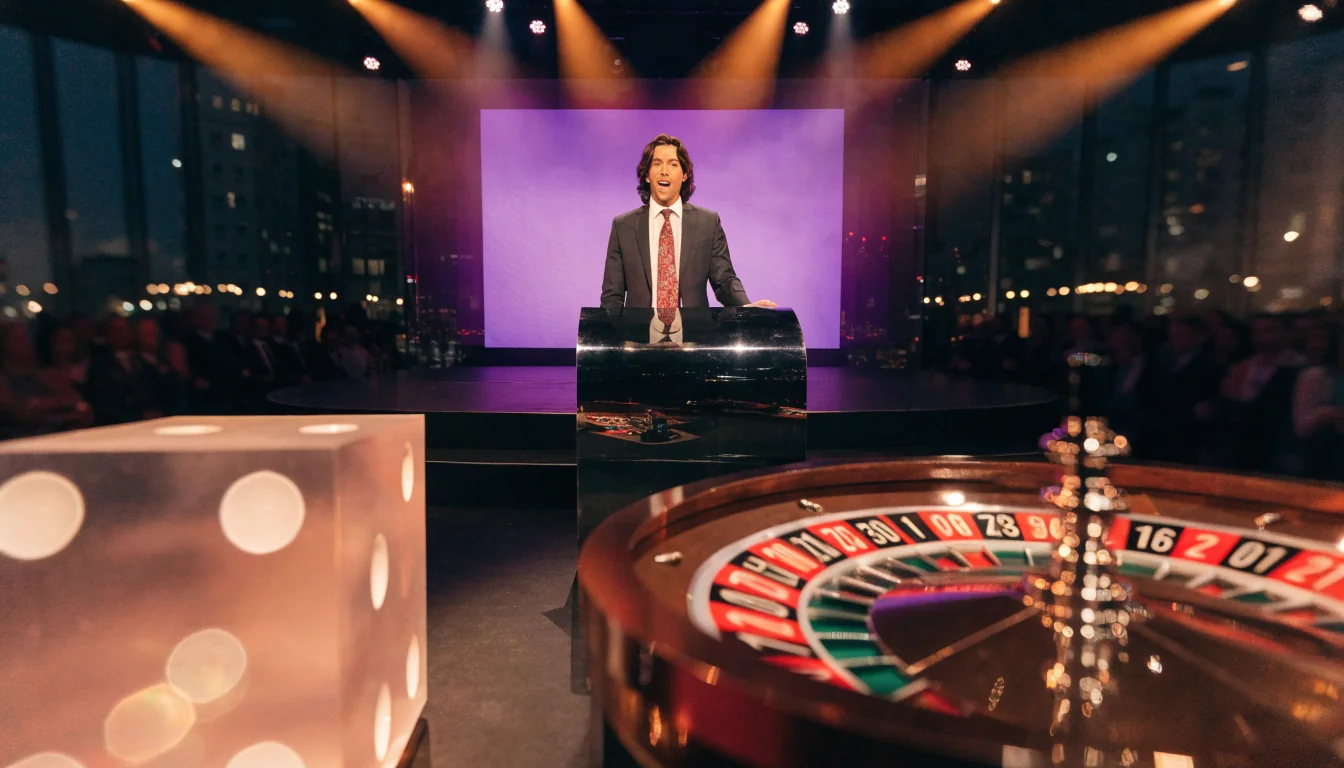
Table of Contents
- The Live-Show Format in an Online Casino
- When a Casino Game Becomes a Show
- Live Casino Shows as an Online Format
- What a ‘Best’ Game-Show Choice Can Mean
- The UK Licensing Framework Behind Online Casinos
- Crazy Time and Funky Time in the Search Landscape
- Finding Live Game Shows in UK Casino Searches
- Comparing Live Casino Game-Show Options
- A Single Live Game-Show Search
- Game Shows Played Online
The Live-Show Format in an Online Casino
An online casino is often imagined as a collection of games reduced to screens: a reel that turns, a card that appears, a result delivered without ceremony. Live-show entertainment belongs to the same digital setting, but it borrows a different kind of attention. Its organising image is not simply the game in motion. It is a programme being presented, with a host or other visible performance at its centre.
That distinction matters because the word “live” can do more than one job. In a live casino, it may describe a game presented in real time, including familiar table formats. A live game show suggests something more theatrical: play framed as an event, with presentation shaping how the experience is understood. The category sits between gambling and broadcast entertainment, though it is not a television programme merely because it looks toward a camera. The casino context remains part of its identity.
Other online casino games are commonly encountered through interfaces that keep the machinery in the foreground. A slot, for instance, presents symbols and a result; a digital table game presents a playing surface and its rules. Their visual style can be elaborate, but the user’s attention is directed chiefly towards the game state. A hosted show shifts some of that attention to the act of presentation: a person, a voice, a sequence of announcements, or the feeling that something is being staged rather than merely generated.
This is a difference of emphasis, not a neat border. A game can be visually dramatic without becoming a show, while a hosted format can still depend on recognisable game rules. The categories overlap in the way entertainment categories tend to overlap: one describes the activity, another the way it is packaged. The word “show” signals a social and performative frame around play, not a guarantee that every example follows the same structure.
The online setting changes the relationship between performer and audience. A broadcast-style presentation may appear on a personal screen, where the surroundings are private and the programme is encountered alongside other casino options. The old arrangement of a room gathered around a stage is absent. In its place is a screen that can make a spectacle feel intimate, although the intimacy is largely a matter of scale. A face fills the display; the audience remains elsewhere.
That arrangement has a long cultural lineage. Games have often been made more watchable by giving them a presenter, a ritual, or a moment of suspense. Radio and television learned that rules alone rarely hold attention for long; voices and pacing make an event legible to people who may not know every rule in advance. Online casinos borrow from that grammar. The format can make play feel less like operating a piece of software and more like entering a performance already under way.
Yet the resemblance to broadcast entertainment should not obscure the central difference. A conventional programme is generally watched for its own sake. Casino entertainment places the possibility of wagering inside the experience. That changes the meaning of the spectacle: suspense is not only a narrative device, but part of an activity with financial consequences. The polished surface may resemble a game show, while the context remains that of remote gambling.
For that reason, the broad label is useful but not especially precise. It gathers together experiences whose shared quality is presentation, not necessarily identical rules, pacing, or audience involvement. Some may place the host at the centre; others may give more weight to graphics or a recurring sequence. The label alone cannot establish what a particular game looks like, how it is played, or whether it is offered by any particular casino. A category is not a catalogue.

The phrase “online casino game show” can therefore be read as a meeting of two forms. “Casino” identifies the setting and the possibility of play; “show” points to presentation and spectacle; “online” describes the screen-based route between them. In Britain, the wording also evokes a familiar split in leisure: entertainment that once required a venue now arrives through a private device, while retaining the theatrical language of a public event. The room has become optional. The performance has not.
This framing helps separate hosted entertainment from the wider world of live casino games without pretending that every boundary is fixed. A live dealer at a table may create a real-time social atmosphere, but that does not automatically make the experience a game show. Conversely, a show-like presentation can remain rooted in casino play even when it borrows the pace and visual cues of television. The distinction is less about a single prop or screen effect than about what the format asks the audience to notice.
At its broadest, then, the live-show format is a way of presenting casino play as an occasion rather than as a bare interface. It gives performance a place beside the rules and results, turning the screen into a small stage. That is the useful starting point—not a promise of uniform entertainment, but a description of the family resemblance that brings these experiences together.
When a Casino Game Becomes a Show
A casino game becomes a show when its presentation is part of the proposition. The distinction is not simply that one is played for money and the other is watched. It lies in the way the activity is framed: as an event with a public-facing performance, rather than as a game whose visual design exists mainly to explain its rules and display its result.
The word “show” carries a small history of its own. It belongs to theatres, television studios and parlours where entertainment has an audience, even when that audience is also invited to take part. A game show borrows this social arrangement. Someone presents; something happens; people follow the unfolding action. The casino setting adds a wager, but does not erase the older grammar of performance.
That grammar matters because “live casino” is a broader expression. It can describe a live-dealer table, where a dealer conducts a familiar casino game, as well as more theatrical entertainment. A game-show format sits within that larger category, but changes the emphasis. The central question is no longer only what game is being played. It is also how the activity is staged and understood as an entertainment event.
A conventional table game tends to make its rules the organising principle. The table, cards or wheel establish the scene; the dealer’s role is to conduct the game; the outcome resolves the round. A show-led format places more weight on presentation and atmosphere. The game remains consequential, but it is wrapped in a more overt performance. That does not make it a television programme in the ordinary sense, nor does it mean that every live casino attraction qualifies as a game show. The label signals a particular kind of framing, not a guarantee of any one set of features.
This is why the phrase “casino game show” can feel slightly unstable. It joins two institutions that have different purposes. The game belongs to a system of rules and outcomes. The show belongs to a system of attention: pacing, anticipation and the pleasure of seeing something unfold. Their union makes the activity legible as entertainment, while retaining the underlying logic of casino play. The spectacle may soften the edges of that logic, but it cannot make chance into theatre alone.
A live dealer is not necessarily a game show; the latter requires a deliberate entertainment frame where presentation is central to the offer rather than incidental to the activity.
The distinction also explains why a live dealer is not, by itself, enough to turn a casino game into a show. A person appearing on screen may simply be the visible operator of a traditional game. The show element implies a more deliberate entertainment frame: the presentation is not incidental to the activity but part of how it is offered. Still, the boundary is a matter of format, not a precise technical test. The same broad category can contain restrained table play and more elaborate entertainment without requiring them to be treated as the same thing.
There is a social difference, too. A table game imagines a player attending to a contest, even when the other participants are unseen. A show imagines an audience gathered around a sequence of events. Online, those positions can overlap: a person may be participant and spectator at once. The appeal of the format lies partly in that double role. Watching is not merely a pause between decisions; presentation itself becomes part of the experience.
That mixture can make the term useful, but also imprecise. Some casino entertainment is live without being a game show; some games borrow the language of spectacle without changing their underlying structure. The label therefore works best as a description of emphasis. It points towards entertainment built around a game, rather than every game presented live.
The wording promises a frame, not a verdict. It says that play is being made visible as performance, with the audience close to the action and the rules still in force. Show business has always known how to hold attention. Casinos have their own reasons for doing the same.

Live Casino Shows as an Online Format
Moving a casino show online changes the setting before it changes the game. What might once have required a shared room becomes an experience reached through a personal screen, at home or elsewhere. The event is no longer tied to a venue that gathers everyone in one place. Instead, the online casino provides the point of access, while each participant encounters the show from a separate location.
That separation is the defining condition of live casino game shows online. The word “live” suggests an unfolding presentation rather than a pre-recorded sequence; “online” describes how people reach it. Neither term, by itself, establishes the exact production style, the pace of play or the rules. Those details belong to the individual offering, not to the category as a whole.
The distinction matters because digital gambling often makes unlike things look similar. A game built around software can appear beside a live presentation in the same casino environment, yet the two do not share the same relationship with time. One may be generated and played as a self-contained digital activity; the other is framed as an event taking place as it is watched. The screen brings both within reach, but it does not make them the same kind of experience.
An online format also divides attention in a way a physical venue cannot quite do. The participant may be alone, with the show occupying a phone or computer among other tabs, household sounds and interruptions. A casino floor gathers people into a designed environment; a remote screen carries only part of that atmosphere across distance. The result is less a miniature casino than a different social arrangement: an event made available individually, without requiring a common room.

That arrangement has a cultural history of its own. Broadcasting has long allowed an audience to share an event without sharing a place. Online casino entertainment borrows that basic condition, while attaching participation to a gambling setting. The audience is dispersed, the presentation is mediated, and the interface becomes the narrow bridge between watching and taking part. It is an old social idea in a newer commercial room.
The phrase “online casino game shows” can therefore refer to more than a set of rules. It points to a format in which presentation and participation are joined through a digital service. But the label should not be mistaken for a guarantee that every offering works alike. A category name is a shelf, not a full description. The particular experience depends on the game and the way it is delivered, details that cannot safely be inferred from the words alone.
For people looking at UK live casino shows, the online setting may be the first practical distinction: the activity is accessed remotely rather than through attendance at a casino venue. That says nothing, on its own, about which titles are offered or whether a given service carries them. Availability is a separate question. So is the character of any specific show.
The screen makes distance seem small. It does not erase it. A live presentation can create a sense of shared time, while the people watching remain scattered across private spaces, each encountering the same event through an individual device. That tension is part of the format’s appeal and its limits: collective viewing, privately arranged.
What a ‘Best’ Game-Show Choice Can Mean
Choosing an online casino for game shows involves more than the games themselves. This list offers a concise reference point, including the stated payout speed for each operator.
Payout speed: 1-3 business days Chanze lists a payout speed of 1–3 business days.
Payout speed: 1-3 business days WinBeast lists a payout speed of 1–3 business days.
Payout speed: 1-3 business days EvoSpin lists a payout speed of 1–3 business days.
Payout speed: 1-3 business days SpinFormula lists a payout speed of 1–3 business days.
Payout speed: 1-3 business days SlotoSport lists a payout speed of 1–3 business days.
Payout speed: 1-3 business days Amunbet lists a payout speed of 1–3 business days.
Payout speed: 1-3 business days BeOnBet lists a payout speed of 1–3 business days.
Payout speed: 1-3 business days Britsino lists a payout speed of 1–3 business days.
Payout speed: 1-3 business days Jetsetspins lists a payout speed of 1–3 business days.
Payout speed: 1-3 business days x3bet lists a payout speed of 1–3 business days.
“Best” sounds like a verdict, but in a guide to online casino game shows it is more useful as a question about priorities. One person may care most about how a show holds attention; another may prefer a format that is easy to follow without sustained concentration. Neither preference establishes a universal winner. It describes a different measure of suitability.
That distinction matters because a ranked list can look more definite than the evidence beneath it. A title placed first appears to have beaten the rest on some shared scale. Unless the guide explains that scale and has reliable information about each option, the order is decoration. A confident heading cannot supply the missing comparison.
A careful assessment would start by making its criteria visible. These might concern the clarity of the rules, the pace of play, the balance between presentation and decision-making, or how readily someone can understand what is happening. Such qualities are not interchangeable, and they are not all objective. Clarity can be discussed through the information a game provides; whether its pace feels lively or tiring remains a matter of taste.
- Consider the clarity of the rules
- Assess the balance between presentation and decisions
- Evaluate how readily the game can be understood
- Treat excitement as the only measure
- Assume more stimulation is always better
- Mistake a ranked list for a universal winner
There is also a difference between a show that seems appealing in description and one that suits a particular player’s habits. Spectacle may be part of the attraction, but it is not a substitute for understanding the mechanics or the stakes. A guide that treats excitement as the only measure quietly assumes that more stimulation is always better. That is a sales principle, not an argument.
The word “best” can therefore be read in several narrower ways: most accessible to a newcomer, most engaging for someone who enjoys a lively presentation, or most straightforward for a person who prefers to follow play without extra layers of entertainment. These are possible editorial lenses, not verified awards. Their value depends on being stated honestly, rather than smuggled into a single league table.
Even a sensible set of criteria has limits. Experience depends on what the player enjoys, and descriptions cannot settle that in advance. A guide can explain what it is judging and distinguish observable details from taste; it cannot turn personal preference into an objective fact. The modest claim is often the more useful one.
The word “UK” in a request for the best live casino game shows narrows the setting, but it does not itself identify a winner. Nor does adding a year make a judgement more secure. A current label may date a page; it cannot replace clear evidence or a declared method. The more polished the ranking, the easier it is to mistake presentation for proof.

For that reason, a sound guide should resist naming a champion where it cannot show why that choice prevailed. It can instead describe the qualities by which a reader might make sense of the options, while keeping factual claims separate from opinion. That approach is less theatrical than a numbered podium. It is also fairer to a subject built around entertainment, where preference is part of the point.
The UK Licensing Framework Behind Online Casinos
A casino seen through a screen remains part of a regulated gambling industry. In the United Kingdom, the Gambling Commission oversees gambling activity, including online casinos. For remote gambling offered to consumers in Great Britain, the location of the equipment carrying the service does not decide whether the Commission’s rules apply. A platform’s servers may sit elsewhere; the regulatory question follows the market it serves.
That principle matters to online casinos with live game shows because the screen does not create a separate legal territory. A hosted format may look unlike a conventional casino game, but its presentation does not, by itself, place the gambling outside the framework for remote gambling. The regulator’s concern is the commercial activity offered to consumers, not simply the room, studio or device through which it appears.
The distinction between Great Britain and the United Kingdom also deserves care. The Commission regulates commercial gambling in Great Britain and is the sole regulator for that activity there. Its role is not a general licence for every form of entertainment carrying casino language, nor does the name of a programme establish anything about the legal status of a business. Regulation attaches to the gambling activity and the entities operating it.
Regulatory Compliance
Remote gambling offered to consumers in Great Britain must be conducted by entities holding the relevant Gambling Commission licence, regardless of where the servers are located.
Licensing separates those entities by role. Businesses receive operating licences; individuals working in relevant operating roles may require personal licences. The first authorises a company to conduct the activities covered by its licence, while the second concerns people who operate within the regulated industry. These are different kinds of permission, not interchangeable stamps of reassurance. The distinction is administrative, but it reflects an older and more consequential idea: responsibility belongs both to the institution that offers gambling and, in specified roles, to people who run it.
For a UK casino offering live entertainment alongside gambling, the format does not substitute for the business’s regulatory obligations. The relevant framework is concerned with remote gambling reaching consumers in Great Britain, even where key equipment is located abroad. Geography has not disappeared; it has simply ceased to be a reliable defence for a business selling into the market.
This helps explain why a search for an online casino with live game shows is also, indirectly, a question about who is permitted to provide remote gambling. The programme may be the visible part of the experience, but the regulated relationship sits behind it: a licensed business offers the activity, and the Commission supervises commercial gambling within its remit. The distinction is less theatrical than the show. It matters more.
Licences are not descriptions of a casino’s entertainment catalogue. They define the regulated business and the activities it may conduct. Nor does the existence of a regulator mean that every casino service, wherever encountered, belongs to the regulated British market. The framework is tied to the conduct of gambling and the consumers to whom it is offered.
In that sense, regulation is the quiet architecture beneath an online casino. A live show may supply the visible drama; the licence supplies the conditions under which the business can operate.
Crazy Time and Funky Time in the Search Landscape
Crazy Time and Funky Time are names that can bring a particular kind of expectation to an online casino search: not simply a game, but a game presented as a show. The wording around them often joins a title to “live casino” or “game show”, as if the name and the format were one thing. They are related ideas, but not interchangeable ones. A title identifies what someone is looking for; “live game show” describes the kind of experience they hope to find.
That distinction matters because a name in a search result is not proof of what is currently available. Casino menus change, and a page that mentions a title may be a review, an old listing or a description rather than a route to play. Even a result that appears to match the phrase “Crazy Time live casino game show” needs to be read for what it actually says. The language of discovery is often more confident than the information behind it.
Funky Time raises the same issue. Someone looking for a live casino game show under that name may be trying to locate a specific title, or may be using its name as shorthand for a broader kind of entertainment. Those intentions can sit close together in a search box and diverge once the results appear. One concerns a named game; the other concerns the hosted-show idea that gives the search its shape.
The names also carry the weight of recognition. A person may encounter a title in conversation, in a casino lobby or in an article, then use it to find out whether it belongs to the kind of play they have in mind. That is an ordinary way to navigate a crowded market: start with the proper noun and hope it leads to the right category. The difficulty is that a familiar name can make a page seem more specific than it is.
A careful description keeps the boundaries visible. Crazy Time and Funky Time can be discussed as named subjects within searches for live casino game shows, without assuming what either offers, how it works or where it can be played. The surrounding words express an intention, not a guarantee. A title on a page does not by itself establish that the same title is present in a casino’s current catalogue.

This is less a technical puzzle than a small feature of modern shopping. Names travel ahead of their context. They are repeated, shortened and attached to categories, while the underlying product may be described differently from one page to another. In casino entertainment, that gap between label and confirmation is worth noticing. A name is a lead, not a receipt.
Finding Live Game Shows in UK Casino Searches
Adding “UK” to a request for live casino game shows changes its emphasis. The interest is not simply in a hosted game online, but in whether the experience belongs to the British market: whether it is presented through a casino serving that market and under the conditions that apply there. The location word carries practical weight, even when the format itself looks international.
That distinction matters because a familiar label does not establish where a game can be accessed. A title discussed on a forum, in a video or on a foreign casino’s page may be part of the wider conversation without being available through a British-facing service. Nor does a casino’s general presence in the UK establish that every category of game is in its catalogue. Availability is a matter of the particular operator and its current offering, not a promise contained in the phrase “live game shows”.
The word “best” adds another expectation, but it does not settle what the searcher values. One person may be interested in a recognisable presenter-led setting; another may care more about the pace, the rules, or how easily a format can be understood from a phone screen. Those are different ideas of quality. A UK-focused guide can clarify the questions behind the phrase without turning an unverified catalogue into a league table.
The national qualifier also points to a distinction between British terminology and British regulation. Great Britain’s Gambling Commission oversees remote gambling offered to consumers there, including when the operator’s key equipment is elsewhere. Businesses offering remote gambling to that market need the relevant UKGC licence. Northern Ireland has a different legal framework from England, Wales and Scotland, so “UK” can be convenient shorthand in everyday browsing while still covering distinct jurisdictions.
Verify Casino Legitimacy
- Check if the operator holds a UKGC licence
- Confirm the specific game show is available in the catalogue
- Verify the service is authorised to serve British customers
A casino’s licence and a show’s presence are separate matters. A licensed operator may provide many kinds of gambling, but the licence alone does not confirm that a particular live game-show format is available. Conversely, a page describing a show does not, by itself, establish that its casino is authorised to serve British customers. Two checks, not one.
This is why British wording often combines the entertainment category with the market in which it is sought. The first part describes the kind of experience; the second narrows the setting. Together they suggest a practical concern about local access, rather than proof that a particular provider or title has been checked. Search language is a map of interest, not a catalogue.
The market context is also more than a label on a webpage. Legal online casino play in Britain takes place through UKGC-licensed operators, with the regulator’s rules applying to the service offered to local customers. That framework belongs in the background of any UK-focused discussion, even when the immediate subject is entertainment rather than legislation. Its presence is not a verdict on which show is most enjoyable. It marks the boundary between a British-facing casino service and a page merely visible from Britain.
So a UK-specific request is best understood as a request for relevance: a live game-show experience connected to the local casino market, not simply an internationally visible name. Availability still has to be established at the operator level. The label opens the door; it does not say what is inside.
Comparing Live Casino Game-Show Options
Comparisons are useful when they reveal what differs, rather than pretending that one title can suit every mood. A list presented as the definitive choice may look decisive, but without a stated basis it says little: one person may value a lively presentation, another may prefer a calmer pace or a format that is easy to follow. “Best” is not a property that can be separated from the person doing the choosing.
A more meaningful comparison begins with the experience sought. The tone of the presentation matters, as does the balance between watching and making decisions through the game interface. Some people are drawn to a sense of occasion; others want straightforward rules and few interruptions. These are not interchangeable preferences, and a single overall score tends to flatten them into a tidy but unhelpful answer.
Clarity deserves particular attention. A game can look polished yet leave its basic structure difficult to grasp. Before money is involved, its instructions should make clear how participation works, what choices are available and how the result is determined. That is not a claim about which show is more entertaining. It is a practical distinction between a format that can be understood and one that asks for attention before explaining itself.
The surrounding experience can also shape a comparison: the screen layout, the prominence of the host or presentation, and how easily the essential information can be found. These observations are best treated as questions to assess, not as universal measures. A busy interface may feel energetic to one person and distracting to another. Taste is stubbornly individual.
A careful guide to live casino game-show options should therefore set out its criteria and acknowledge their limits. If it cannot support a ranking with consistent, current evidence, it should not dress preference up as measurement. Categories such as presentation, ease of understanding and personal pace can help organise a choice without suggesting that every option has been tested on equal terms.
There is also a difference between comparing a show and comparing the place where it is offered. The game’s presentation does not settle questions about the casino, its terms or the way an account is handled. Those belong to a separate assessment. Keeping the two distinct prevents a lively set from lending borrowed credibility to the service around it. A comparison can guide attention; it cannot make uncertainty disappear.
A Single Live Game-Show Search
A request for a casino centred on live game shows can sound more definite than it is. It may point to a single destination, to one particular kind of entertainment within a casino, or simply to a wish to avoid the familiar rows of standalone digital games. The wording gathers these possibilities together without settling which one matters most.
That ambiguity is ordinary. People often name the place they hope to find before they know what its catalogue contains. Yet a casino is not itself a promise that any specific show will be available there. A title may be absent, withdrawn or presented differently across services; the label alone cannot establish what is currently offered.
There is also a small difference between asking for a casino and asking for a game. One is an operator, with the account and customer relationship attached to it. The other is an individual product within a wider catalogue. Blurring the two makes a neat phrase, but not a reliable description of what is on screen.
The sensible reading, then, is modest: the interest is in a casino setting associated with live, hosted game-show entertainment, rather than in a confirmed venue or named title. Nothing more can be inferred from the wording alone. It is a direction, not a directory.
Game Shows Played Online
An online casino game show exists at the meeting point of a screen-based broadcast and a gambling interface. Its setting changes the old arrangement of a room: the audience is no longer gathered around a physical stage, and participation is mediated by a device. The performance and the play occupy the same digital space, though they remain different things. Watching the presentation does not, by itself, mean placing a bet.
That distinction matters because the word “show” can make gambling sound like a harmless extension of television. The familiar grammar of entertainment—an emcee, suspense, a reveal—can soften the fact that money may be at stake. A polished screen does not alter that underlying activity. It simply gives it a more theatrical frame.
Online access also makes the format private and portable. A person may encounter it alone, outside the social setting that once made games of chance visible to others. That privacy can be convenient; it can also remove the small interruptions of shared space, the glance or conversation that might otherwise break a spell. The interface is attentive. It does not need to be.
The useful way to understand game shows played online is therefore not as television with a casino attached, nor as ordinary casino play dressed for an audience. They combine performance with a digital route into play, and the two should not be confused. The screen makes the experience immediate, but immediacy is not the same as consequence. A show may supply colour and suspense; it cannot make a wager less real.
The distinction is modest, but necessary. One is entertainment. The other may cost.
Are Amatic casinos safe and regulated in the UK?
Amatic is a software supplier, not a consumer-facing casino, and holds a UK Gambling Commission remote gambling software licence. The casino offering its games is responsible for holding the operator’s licence and handling deposits, payouts and customer support.
What is the maximum I can stake on Amatic slots in the UK?
The UK online slot limit is £5 per game cycle for players aged 25 and over, and £2 for players aged 18 to 24.
Do Amatic casinos work on mobile phones and tablets?
Amatic games generally run in a mobile browser as HTML5 games, without a download.
Do Amatic slots come with their own welcome bonus or free spins?
Amatic does not operate casinos or provide its own consumer welcome bonuses. Casino operators set their own promotions; some UK operators offer free-spin wins with no wagering requirement.
How do Amatic slots perform on a mobile browser?
They generally run as HTML5 games in a mobile browser, without requiring a download.
Created by the ”Tenobet Casino 4” editorial team.