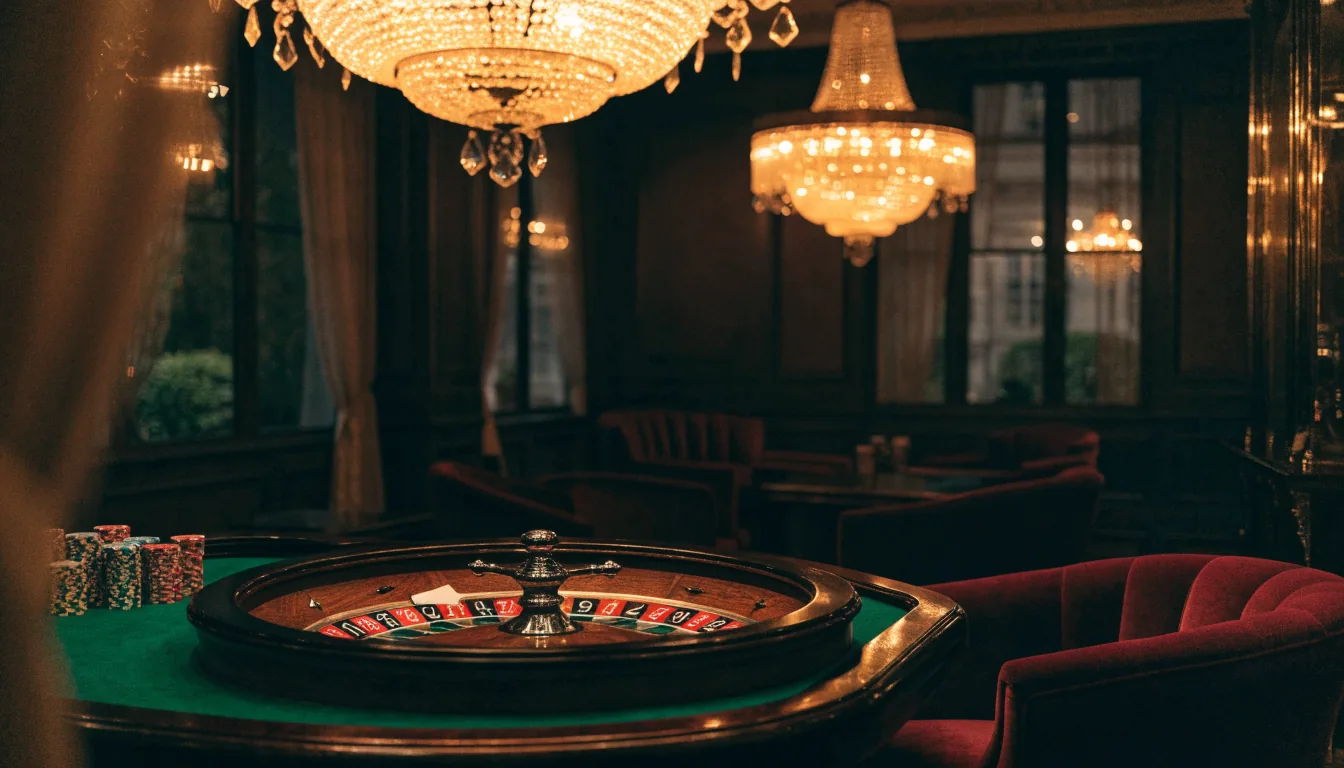
Progressive Jackpot Slots: How Shared Prizes Work
 Available in GB
Progressive prizes draw contributions from connected play, so the displayed casino may be only one part of a wider network.

Table of Contents
- How Progressive Jackpots Grow Across Casino Networks
- The Online Jackpot: A Share of Every Wager
- When a Game Releases the Jackpot
- From Connected Machines to the Screen
- The UK Framework Behind Progressive Slots
- Free Spins, Demo Play and the Limits of ‘Free’
- Why a Slot May Appear on One Site and Not Another
- Reading the Return Beneath the Jackpot
- A Progressive Prize Is a Pool, Not a Fixed Payout
- What ‘With a Progressive Jackpot’ Means in Play
How Progressive Jackpots Grow Across Casino Networks
A progressive jackpot can look like a feature belonging to one slot, or even to one casino. Its visible position beside the reels encourages that impression: this game, this place, this prize. The underlying arrangement is wider. Connected slot machines contribute to a shared pool, and the same progressive game can link play across operators that carry it. The casino displaying the game is therefore not necessarily the boundary of the jackpot.
The network is organised around the game rather than the name above the casino door. When several operators offer the same progressive slot, their connected machines can feed the same prize pool. A player may encounter the game in one casino account, while other connected play elsewhere also contributes to that pool. The result is a jackpot with a wider constituency than any single operator’s customer base.
That distinction matters because the word “casino” does several jobs at once. It can mean the business, the collection of games, or the setting in which a person plays. In a progressive jackpot casino slot, those meanings sit close together but are not interchangeable. The operator supplies the setting; the game belongs to a provider’s catalogue; the pool is shared across the connected machines carrying that same game. A single screen can conceal several layers of organisation.
Progressive jackpot play can make payout arrangements an important part of choosing where to play. This list provides a quick reference to the payout-speed information available for each operator.
Payout speed: 1-3 business days Chanze has a stated payout speed of 1–3 business days. This is the available payment-related detail for considering it on a progressive jackpot slots page.
Payout speed: 1-3 business days WinBeast lists a payout speed of 1–3 business days. No other operator details are provided here.
Payout speed: 1-3 business days EvoSpin’s stated payout speed is 1–3 business days. That timing is the only supplied fact to note for this reference card.
Payout speed: 1-3 business days SpinFormula has a listed payout speed of 1–3 business days. Further details about its progressive jackpot slots are not provided.
Payout speed: 1-3 business days SlotoSport reports a payout speed of 1–3 business days. This is the sole confirmed detail available for its entry.
Payout speed: 1-3 business days Amunbet’s stated payout speed is 1–3 business days. No information about its games or other features is supplied.
Payout speed: 1-3 business days BeOnBet lists payouts as taking 1–3 business days. That is the available factual point for this entry.
Payout speed: 1-3 business days Britsino has a stated payout speed of 1–3 business days. No further details are available in the supplied information.
Payout speed: 1-3 business days Jetsetspins lists a payout speed of 1–3 business days. Its progressive jackpot offering cannot be described from the information provided.
Payout speed: 1-3 business days x3bet’s stated payout speed is 1–3 business days. No other operator attributes are supplied for this reference.
The network does not mean that every progressive game contributes to one universal prize. The shared pool belongs to the connected version of a particular game. Another slot, even one with a similar theme or a jackpot display of its own, is not part of that pool merely because it appears in the same casino. The relevant connection is between machines running the same progressive game, not between all the games under one commercial roof.
This helps explain why the jackpot may continue to grow while a particular casino is quiet, or why the displayed prize can reflect activity beyond the operator showing it. Connected play is the source of the pool’s growth. The amount visible on one machine represents a shared arrangement, not a private reserve assembled solely from wagers at that casino. The network makes a local display legible only as a window onto something larger.
A casino’s branding can make the arrangement seem more contained than it is. The lobby, account and game menu are presented as one place, with a familiar name holding the whole experience together. Progressive jackpots resist that neat packaging. A casino may host the game, but the pool can cross operator boundaries wherever the same progressive slot is carried and connected. The prize belongs to the network’s play, not exclusively to the casino presenting it.
For progressive jackpot casinos in the UK, this is a useful way to read the word “shared”. It does not mean that all operators have one common jackpot fund for every game. It means that operators carrying the same progressive slot can participate in the same game-specific pool. The boundary follows the connected game. That is a narrower claim than a universal network, but a more consequential one than a jackpot confined to a single account.
The arrangement also changes the social scale of a spin. The reels turn in one player’s session, on one screen, but the prize is shaped by connected activity beyond that moment and location. A casino may be the visible stage; it is not necessarily the whole audience. The network gives the game a collective dimension without making the experience itself communal. Each play remains separate, while its contribution joins a pool that other connected machines also feed.

That separation is easy to miss because casino software turns an infrastructure into an image: a number beside the reels. The display does not show the full map of connected machines or operators. It presents the outcome of a network as a single figure attached to a single game. The interface is compact; the arrangement behind it is not.
The same principle applies whether a progressive slot is encountered under the label of an online casino or another casino setting. The important question is not simply which operator displays the title, but whether that operator carries the same connected progressive game. Where it does, the jackpot pool can span operators. Where the game is different, a similar name or appearance does not establish a shared pool.
A progressive jackpot, then, is neither quite local nor indiscriminately global. It grows through wagers placed on connected machines, and it can be shared among operators offering the same game. The casino gives the player a point of entry; the network defines the pool’s reach. One screen, many contributors.
The Online Jackpot: A Share of Every Wager
A progressive jackpot is funded in small deductions from play, rather than being a fixed prize waiting beside the reels. With progressive jackpot slots online, a portion of each wager is directed into the jackpot pool. The share is typically between 1% and 3%. The rest supports the game’s ordinary payout structure, though the split is not always visible in the interface.
That contribution is easy to mistake for a separate fee. It is better understood as part of the game’s payout design: a slice of the stake is assigned to a prize that grows through continued play. The player makes one wager, but its expected return is divided between two destinations—the base game and the progressive prize. One is encountered in ordinary play; the other accumulates.
The distinction matters because a jackpot figure can dominate the screen while saying little about the base game’s own return. A large pool is not evidence that ordinary spins pay generously, nor does a modest pool tell the whole story about a game’s mathematics. The headline prize and the base game RTP describe different parts of the arrangement.

For progressive slots, the base game RTP often falls in the 88%–92% range. The difference in payout is channelled towards the jackpot pool. In other words, the advertised or theoretical return of the reels should not be read as though it accounts for every part of the game’s payout structure. Some value is set aside for a prize that does not arrive as a routine result on each spin.
This is the central calculation behind online progressive jackpot slots: part of the wager supports the ordinary game, while another part feeds the progressive prize. The precise contribution varies by game, but the stated range gives a sense of scale. It does not mean that every spin returns a corresponding share to the player, or that a particular stake produces a predictable movement in the visible jackpot. The contribution is pooled, not handed back as an immediate payment.
That separation also changes how “return” is read. RTP is a long-run measure of the game’s designed payouts, not a promise about an individual session. A base game figure in the stated range concerns the ordinary slot’s return; the jackpot contribution belongs to the wider prize structure. Combining the two without noting the distinction can make the game appear more generous on paper than its routine play suggests.
The same principle applies to an online slots game with a progressive jackpot whether the prize meter is prominent or tucked into the interface. The display shows the accumulated pool, while the funding mechanism operates through wagers. It is possible to see the total rise without seeing the individual contributions that built it. The interface presents a spectacle; the accounting is quieter.
This is also why “best” cannot be settled by the jackpot amount alone. A larger displayed prize may be compelling, but it does not disclose the base game’s RTP or explain how the stake is divided. Those details belong together when assessing the mathematics. A prize can be enormous and still sit beside a comparatively lower base-game return. The arithmetic is less theatrical.
For progressive slots, the base game RTP often falls in the 88%–92% range, with the remaining portion of each wager (typically 1% to 3%) directed into the jackpot pool.
Free online progressive jackpot slots can make the structure seem detached from money because no cash stake is being placed in that session. But the funding logic described here concerns wagers that contribute to the pool; a demonstration of the reels is not itself evidence of a real-money contribution. The visual jackpot and the financial mechanism are not the same thing.
The appeal is plain: a small part of ordinary play is attached to an exceptional prize. Yet that promise does not erase the other part of the bargain. The base game has its own return profile, and the progressive pool has its own share of the wager. Two forms of payout, one stake.
When a Game Releases the Jackpot
A progressive jackpot can be visible throughout a game without being available on every spin. Its release depends on the trigger built into that particular title. Some progressive jackpot slot games use a random trigger; others attach the prize to a defined combination or to entry into a bonus round. The reels may look similar, but the route to the prize can be quite different.
A random trigger does not announce itself through a particular sequence of symbols. The game may award the jackpot during ordinary play, rather than waiting for a player to assemble a winning line or reach a separate feature. That can make the event feel sudden: one spin is part of the routine, the next is the exceptional one. But “random” describes the mechanism, not a promise that a prize is due after a run of unsuccessful spins. Past results do not reveal when the next trigger will occur.

Other games make the route more visible. A specified combination may be required, or a bonus feature may provide the point at which the progressive prize can be released. Those conditions give the game a recognisable structure, but reaching a feature should not be confused with winning the jackpot unless the rules say that the feature itself awards it. A bonus round can be a gateway, not necessarily the prize.
The distinction matters because the words “jackpot slot” can suggest a single, simple event: a big symbol appears, and the prize follows. In practice, the game’s rules define what counts. A combination may need to appear in a particular way, while a bonus-triggered prize depends on the feature’s stated conditions. For a random-trigger game, the rules explain how eligibility works even though the moment of release is not signalled by a visible combination.
That makes the game information more useful than the jackpot display alone. A large amount beside the reels says what may be won; it does not explain how. The trigger description answers a different question: whether the prize is attached to a symbol pattern, a bonus route or a random event. For anyone comparing popular progressive jackpot slot games, those mechanics are more meaningful than treating every title as though it offered the same kind of chance.
There is also a qualification that can matter in random-trigger games. A specialist review reports that certain titles make eligibility for the highest jackpot tier conditional on placing at least a specified bet. This is a condition attached to some games, not a general rule for progressive jackpot casino games. A qualifying bet may make a tier available; it does not make the trigger certain, nor does it mean that every random jackpot uses the same arrangement.
Attention: Certain titles make eligibility for the highest jackpot tier conditional on placing at least a specified minimum bet.
The distinction between eligibility and outcome is easy to blur. A minimum bet, where a game imposes one, defines who can enter the relevant tier under its rules. It does not turn the spin into a guaranteed award. That is a small sentence with a large job.
The biggest progressive jackpot slots may attract attention through the headline prize, but the release mechanism is what gives that headline its practical meaning. A random trigger leaves the moment hidden; a combination or bonus condition makes the route more explicit. Neither description, by itself, reveals how likely a win is. It only tells how the game has arranged the possibility.
This is why a list of the largest progressive slot jackpots cannot explain the experience of playing them. The size of the advertised prize and the condition that releases it are separate features. A title with a conspicuous jackpot may have a trigger quite unlike another title with a similarly prominent display. The rules are not decorative fine print. They are the machinery of the promise.
From Connected Machines to the Screen
A progressive jackpot slot can look like a solitary game: reels on a cabinet, symbols in motion, a prize displayed above them. But its defining feature belongs to a wider arrangement. Contributions from wagers on connected slot machines accumulate in a shared pool. The machine is the visible point of play; the network is what makes the prize progressive.
That distinction matters as slots move from physical cabinets to screens. A cabinet places the game in a room among other machines, making the idea of connection relatively easy to picture. Online, the surrounding room disappears. The reels occupy a phone or computer display, and the wider system is out of sight. Yet the screen does not, by itself, turn a shared jackpot into a separate prize belonging only to that device. The connected play remains the underlying idea.
The change is partly one of scale and partly one of perception. In a casino, nearby machines suggest a common environment, even when their internal links are not visible. On a screen, the game seems more self-contained: a private interface, a single player, a result unfolding in miniature. Progressive jackpot slots carry that older collective logic into a more private-looking form. A solitary screen can be a doorway into shared play.

This is why “slot machine” can be a slightly misleading mental picture when applied to an online progressive game. It evokes a piece of equipment, fixed in place and used by one person at a time. The more useful image is a game represented by a machine, but connected to other play through a common pool. The physical cabinet and the online display are different ways of encountering the game; neither is the pool itself.
There is a quiet social history in that arrangement. The jackpot is presented as a single prize, but its growth depends on activity beyond the individual screen or cabinet. The visible game gives the player an immediate scene: symbols, sounds, a meter that marks the prize. The network supplies the less visible condition that allows the meter to change. One is theatre; the other, infrastructure.
Online play can make the network feel abstract, because there is no row of neighbouring cabinets to point towards. The connection is not made legible by bodies gathered around machines or by a shared physical floor. It is legible through the game’s progressive feature: a prize that draws on connected slot-machine wagers. The interface may be personal. The pool is not.
This also clarifies what “progressive slot machine” means in a digital setting. It need not describe a particular cabinet or a device with moving parts. It can describe a slot game whose jackpot depends on connected play, whether the game is encountered on a casino floor or through a screen. The machine has become less a piece of furniture than a model for the game: reels, a wager, a prize, and a connection beyond the immediate encounter.
The screen changed the setting, not the basic premise. A progressive jackpot remains collective beneath its individual display. A small window onto a large arrangement.
The UK Framework Behind Progressive Slots
A progressive jackpot may look like a feature of the reels, but its place in the British market also depends on a less visible arrangement: commercial gambling is overseen by a public regulator. The UK Gambling Commission regulates gambling activity in the United Kingdom, including online casinos. In Great Britain, it is the sole regulator for commercial gambling.

That role matters whether a progressive jackpot slot is played on a physical machine or through an online casino. Remote gambling offered to consumers in Great Britain falls within the Commission’s remit regardless of where the operator keeps the equipment that runs the service. A server’s location, in other words, does not move the regulatory boundary. The activity is judged by the market it serves.
This is a point easily obscured by the language of online play. A game may be supplied by a company based elsewhere, and the systems supporting it may sit outside Britain, yet the operator offering remote gambling to people in Great Britain remains subject to the relevant Commission requirements. The screen is not a legal border.
The Commission issues two kinds of licence. An operating licence is granted to a business carrying on gambling activities; a personal licence is issued to an individual operating in the sector. They concern different parts of the commercial arrangement: one authorises a business, the other applies to people whose roles fall within the personal licensing system. Neither should be confused with a game’s own jackpot feature. A progressive prize does not itself confer permission to offer gambling.
For anyone considering progressive jackpot slots in the UK, that distinction is more useful than a label on a game page. The slot is the product; the operator is the party offering the gambling service. The Commission’s framework addresses the latter, including remote offers to consumers in Great Britain, rather than turning each jackpot mechanism into a separate licence.
The rules also make the market more than a collection of brands and game catalogues. A business may present a polished lobby and a familiar title, but its commercial activity sits within a system in which the regulator issues operating licences and oversees gambling. The same institutional structure applies to online casinos whether the games are played on a phone, a computer or another screen. Mobile play changes the setting, not the identity of the regulator.
This is the legal backdrop to searches for the best or most popular progressive jackpot slots in Britain. Those descriptions concern taste, availability or promotion; they do not alter who regulates commercial gambling. Nor does a large advertised prize make the operator’s position incidental. The Commission’s remit follows the service offered to consumers, not the spectacle attached to one game.
UK Gambling Commission Licensing
The Commission issues operating licences to businesses carrying on gambling activities and personal licences to individuals operating in the sector. Remote gambling offered to consumers in Great Britain falls within this remit regardless of where the operator’s equipment is located.
A licence is not a decoration beside a casino’s name. It is part of the framework that makes commercial gambling an authorised activity in Great Britain, and it locates responsibility with both businesses and relevant individuals. The jackpot may be the most conspicuous figure on screen. The regulator is the quieter fact behind it.
Free Spins, Demo Play and the Limits of ‘Free’
“Free” can describe very different things on a slot page. Demo play, promotional spins and a no-deposit bonus may all remove the need to place an ordinary cash stake for a particular stretch of play, but they do not necessarily offer the same route to a prize. The label says little about what can be won or withdrawn.
Demo play is a way to try a game without placing real-money wagers. It can show how the reels and features behave, but a result in a demo session is not a cash balance. That distinction matters especially when a progressive jackpot is visible: seeing the prize on screen does not, by itself, mean that a demo spin can claim it. The game’s rules and the operator’s terms determine what counts as eligible play.
Promotional free spins are different. They are issued under an offer and may be limited to named games; most free-spin promotions, according to specialist reviews, are described as excluding progressive titles. Those reviews also report caps of £50–£100 on winnings from free spins on progressive slots. These are reported offer terms, not a dependable market-wide rule. The individual promotion is decisive.

A no-deposit bonus is not simply a pile of unrestricted cash. Specialist reviews report wagering requirements of 40x–60x and maximum withdrawal limits of £50–£100 for such winnings. The requirements can mean that a bonus balance must be played through before any eligible amount can be withdrawn, while a cap can limit what is payable even if the balance grows further. The precise terms belong to the offer, not to the phrase “no deposit”.
That leaves a useful distinction between trying a progressive jackpot slot for free and playing it for real money. Demo play offers a way to explore without turning a displayed result into spendable winnings. A promotion may allow real-money play without an initial deposit, but it remains conditional and can carry restrictions on eligible games, wagering and withdrawal. An ordinary cash-funded spin is not governed by those promotional conditions, though it is still subject to the game’s own rules.
The small print is the substance. A free-spin offer may exclude the very slot it appears beside; a bonus may permit play but limit what can be withdrawn. Before treating a promotion as a route to a progressive prize, its eligible games, contribution rules and cash-out terms need to be read together. “Free” is an entry condition, not a promise of unrestricted winnings.
Why a Slot May Appear on One Site and Not Another
A progressive jackpot slot can be present in one casino’s catalogue and absent from another’s. A specialist review describes availability as varying between operators and changing when providers update their catalogues. That is a narrow observation, but an important one: a game’s presence is not a permanent feature of the whole UK market.
Game availability varies between operators and can change when providers update their catalogues, meaning a title present on one site may be absent from another.
Casino catalogues are not a single national shelf. Each operator presents a collection that can change, while the provider’s own catalogue changes too. The result is that a title found in one place may not appear elsewhere, or may disappear from a catalogue that previously listed it. The word “site” can make these collections sound stable. They are not necessarily so.
This matters when comparing UK sites with progressive jackpot slots. A list assembled at one moment describes what was visible then, not a lasting arrangement. Even a detailed review can become a historical document without changing a word. The internet is excellent at preserving pages and less reliable at preserving their accuracy.
The same caution applies to video slots with progressive jackpots and their demo versions. A game’s appearance in a catalogue does not, by itself, establish that a demo is available there; nor does a demo listing settle whether the real-money version is currently offered. Those are separate questions about what an operator makes accessible at a particular time. Treating them as interchangeable turns a catalogue entry into more evidence than it is.
For anyone comparing a particular title, the useful distinction is between the game existing and the game being listed by a particular operator. Search results, old reviews and saved pages can point towards a game, but they may describe a previous catalogue. The current game list on an operator’s own site is a more direct indication of what it presently offers, though even that is a snapshot.
This is not a ranking of casinos, and a longer catalogue does not automatically make one operator better. The relevant question is more modest: whether the particular progressive slot is available in the catalogue being considered, and whether that information is current. A game’s absence from one site does not establish that it has vanished everywhere. Its presence on another does not promise that it will remain there.

A small uncertainty, repeated across many catalogues.
Reading the Return Beneath the Jackpot
A progressive jackpot can dominate a slot’s display, but its headline prize is only one part of the game’s mathematical picture. The base-game return is another. For progressive slots, that RTP often sits in the 88%–92% range, with the difference in payout directed towards the jackpot pool.
RTP, or return to player, describes a theoretical share of wagers returned through play over the long run. It is not a forecast of what an individual session will return, nor a promise that a particular player will receive that share. The figure also needs reading in context: a progressive slot’s base-game RTP does not necessarily include the value accumulating in its jackpot in the same way as a fixed-prize game’s return.
That distinction matters when comparing progressive jackpot slots. A large displayed prize can make one game look more generous than another, while concealing a lower base-game return. Conversely, a higher base-game RTP does not establish that a game offers better overall value; it says nothing, by itself, about the likelihood of landing the progressive prize or how much that prize may be when it is won.
The word “return” sounds reassuringly settled. The experience is not. RTP is a long-run measure, while jackpot wins are rare events whose timing cannot be read from that percentage. A progressive jackpot slot RTP therefore cannot, on its own, answer the practical question of how likely a jackpot is to fall. Nor does a headline prize supply the missing odds. Those are separate measures.
This is why lists of top-rated progressive jackpot slots can be misleading when they rank games by prize size alone. The jackpot is visible; the underlying return is less theatrical. A meaningful comparison would distinguish the base-game RTP from the progressive prize and avoid treating either as a complete account of a game’s value. Without comparable information on both, a ranking may reflect spectacle more than mathematics.

The same caution applies when a game is encountered through a different payment method or currency. A label such as crypto progressive jackpot slots does not, on its own, explain the game’s RTP or jackpot odds. The relevant figures belong to the game’s terms, not to the currency used to play.
The pool attracts attention. The return needs a closer reading.
A Progressive Prize Is a Pool, Not a Fixed Payout
A fixed jackpot has a set value attached to the game. A progressive prize behaves differently: it changes as play continues, because part of qualifying wagers is added to a shared pool. The figure displayed beside the reels is therefore a moving total, not a promise that the game began with that amount or will keep it unchanged.
In progressive jackpot slots, the contribution is commonly described as a small slice of each wager. The stated range is 1% to 3%, directed to the jackpot pool. Each contribution is modest on its own; the accumulating total is the point. As connected play adds more money, the displayed prize can rise. When the pool is paid out, that accumulated figure changes, and further play begins building it again.
The distinction matters because the jackpot is not simply a decorative number printed on the screen. It represents a fund that grows through play, while the ordinary game continues to operate around it. A progressive slot jackpot is thus less like a fixed prize on a noticeboard and more like a balance being continually replenished—though the balance belongs to the game’s prize structure, not to any individual player.
That is the defining feature, whether the game is called a progressive jackpot slot or a progressive slots jackpot. The label describes a prize whose value can move with ongoing contributions. It does not, by itself, say how large the pool will become, how quickly it will change, or what conditions govern its payment. Those details depend on the particular game.

A number that moves.
What ‘With a Progressive Jackpot’ Means in Play
A slot with a progressive jackpot includes a prize that can change as play continues; the label does not mean that any particular ordinary spin is destined to award it. The distinction is small in wording and large in expectation. A game can offer the chance of a jackpot while leaving each spin’s outcome uncertain.
The route to the prize depends on the game. Some progressive jackpots are triggered at random. Others require a particular symbol combination or entry into a bonus round. Those are different conditions, not different descriptions of a guaranteed payout. Until the relevant trigger occurs, the jackpot remains a feature available within the game rather than a result attached to every turn.
That matters when comparing video slots with progressive jackpots to slots without a progressive prize. The latter do not offer that particular jackpot feature, while the former make it part of the game’s rules. Neither label, by itself, says what a session will return. A progressive prize is a possibility, not a promise. A dry distinction.
For slots with a progressive jackpot in the UK, the practical question is therefore what the game’s own rules say about qualifying and triggering the prize. The name of the feature cannot answer that on its own. Nor does its presence establish that a standard spin will release the jackpot: a random trigger, a required combination and a bonus-round entry each describe a condition that must be met according to the game’s design.
The phrase “with a progressive jackpot” marks an available route to a changing prize. It does not turn the rest of the game into a sequence of near-wins, or make the jackpot the certain destination of play. That is the whole distinction.
Do all UK casinos offer the same progressive jackpot games?
No. Progressive slot availability varies by operator and changes as providers update their catalogues. When operators offer the same connected progressive game, they can share its jackpot pool.
What should I look for in a progressive jackpot slot?
Check how the jackpot is triggered, what share of each wager feeds it, and the base game RTP. Some games also require a minimum bet to qualify for the highest jackpot tier.
Are progressive jackpot slots worth playing?
They offer a chance to contribute to and potentially win a growing jackpot, but the base game RTP is often 88%–92%. Weigh that lower base-game return against the jackpot opportunity.
How fast are progressive jackpot withdrawals paid out?
E-wallet withdrawals can take hours, debit card withdrawals typically take 1–3 working days, and bank transfers often take 3–5 working days or longer. Large jackpot payouts may need extra verification or be paid in installments over several years.
Created by the ”Tenobet Casino 4” editorial team.